

After achieving historic milestones like sending humans beyond Earth’s orbit for the first time in over five decades and setting a new human distance record from Earth, the Artemis II mission is now facing its most critical phase: re-entry. This moment, as exhilarating as the launch, carries significant risk and technical complexity.
While the launch initiated the journey and the lunar flyby was its symbolic peak, the successful return to Earth is paramount for Artemis II’s overall triumph. This final stage subjects all previously tested systems to extreme conditions, as the Orion capsule must endure immense temperatures and execute a perfectly synchronized sequence of maneuvers. Beyond safely returning the crew, this phase is crucial for demonstrating the reliability of NASA’s entire system for future, even more ambitious missions, including human landings on the lunar surface (Artemis IV and beyond).
When and Where Re-entry Will Occur
Artemis II’s re-entry concludes a mission lasting approximately ten days. The Orion “Integrity” capsule successfully completed its lunar flyby and began its return trajectory to Earth, exiting the Moon’s sphere of influence on the evening of April 7 (Italian time) and performing a corrective maneuver overnight between April 7 and 8. The splashdown is anticipated in the Pacific Ocean during the Italian night between April 10 and 11. Specialized naval teams will be strategically positioned in the designated landing zone, prepared for immediate intervention upon Integrity’s impact with the water. This recovery aspect is integral to the mission’s success, as the rapid and safe retrieval of both the capsule and astronauts is as crucial as the space journey itself.

What Happens During Re-entry
Orion’s re-entry is one of the mission’s most technically intricate phases. In a matter of minutes, the capsule transitions from speeds of tens of thousands of kilometers per hour to a controlled descent towards the ocean. Before atmospheric entry, around 01:30 Italian time on April 10, the crew module is scheduled to separate from the European Service Module, which powered and supported the journey. Only the capsule, designed to withstand extreme re-entry conditions, remains with the astronauts. Atmospheric entry occurs at extremely high velocities, causing intense heating of the thermal shield, which must protect the crew from temperatures reaching several thousand degrees. A unique feature of Orion is its “skip reentry” technique, where the capsule enters the atmosphere, briefly ascends, and then re-enters a second time. This method reduces G-forces on the astronauts and enhances trajectory precision.
During the descent, speed progressively decreases until the parachutes deploy – first smaller ones for stabilization, then the main parachutes to slow Orion to a safe splashdown velocity. This sequence, lasting only a few minutes, represents one of the most critical tests of the entire mission.

What Happens After Splashdown
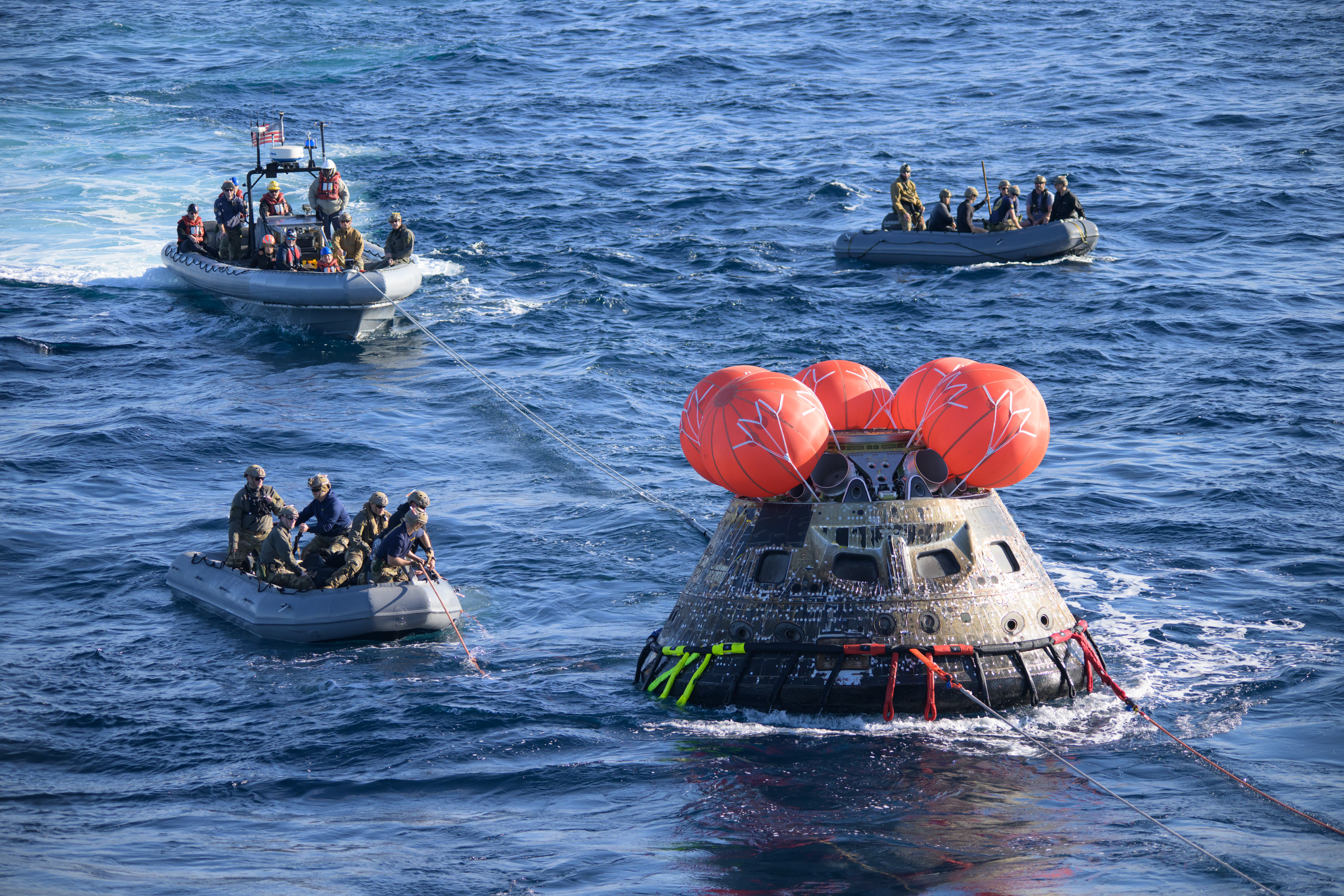
Once the capsule touches down, expected shortly after 02:00 Italian time, the mission is far from over; it enters the equally vital recovery phase. Immediately after splashdown, Orion is stabilized using systems designed to maintain its correct position on the water’s surface. This step is fundamental, ensuring the astronauts remain safe inside the capsule while recovery teams approach.
Within minutes, NASA and U.S. Navy vessels reach the splashdown point and commence securing operations. Specialized technicians assess any risks and establish direct contact with the crew, confirming everything is under control. Only after these checks is the capsule hatch opened, and astronauts are gradually and assisted out, allowing their bodies to readjust to Earth’s gravity after days in space.
Subsequently, Orion is retrieved and hoisted aboard the recovery ship for further inspection. This phase is crucial not only for immediate safety but also for collecting invaluable data pertinent to future missions.
Why It’s Important to Follow This Moment
Artemis II’s re-entry signifies much more than merely concluding a mission; it concretely validates humanity’s capability to journey into deep space and return safely. After decades primarily focused on crewed missions in Earth orbit, this phase marks a return to far more demanding conditions, echoing those faced during the Apollo program but employing entirely new technologies. Every aspect of re-entry—from the thermal shield performance and parachute sequence to the recovery operations—yields essential data for subsequent missions, particularly those involving lunar landings.
Following this event offers a tangible demonstration of recent technological advancements and a deeper understanding of the complexities involved in bringing a crew back to Earth after such an extensive voyage.
Furthermore, it carries a profound symbolic weight: the astronauts’ return closes one chapter while simultaneously opening another. It underscores that human deep space exploration is no longer a historical memory but a living, evolving reality, destined to pursue increasingly ambitious goals in the years to come.