

Four days, six hours, and two minutes after its launch, the Artemis II mission crew achieved a critical milestone on their journey to the Moon: entering the lunar sphere of influence. This designates the region of space where the Moon’s gravitational pull exerts a greater influence on the Orion capsule’s movement than Earth’s. This pivotal event occurred approximately 62,800 km from the Moon and over 373,000 km from Earth, at 6:38 AM Italian time on Monday, April 6.
Aboard the capsule are NASA astronauts Reid Wiseman, Victor Glover, Christina Koch, and Canadian Space Agency (CSA) astronaut Jeremy Hansen. They have now become the 25th, 26th, 27th, and 28th humans to venture beyond “Earth’s space” in 54 years, since the conclusion of the Apollo program in 1972.
The next significant event will be the lunar flyby, a close pass of the Moon scheduled for the night of April 6-7 in Italy.
During this maneuver, the astronauts will travel further from Earth than any human in history, reaching over 10,300 km from the Moon’s surface and approximately 406,000 km from Earth in total. Communications with Earth will be interrupted for about 40 minutes during the flyby as the Moon blocks the radio signal.
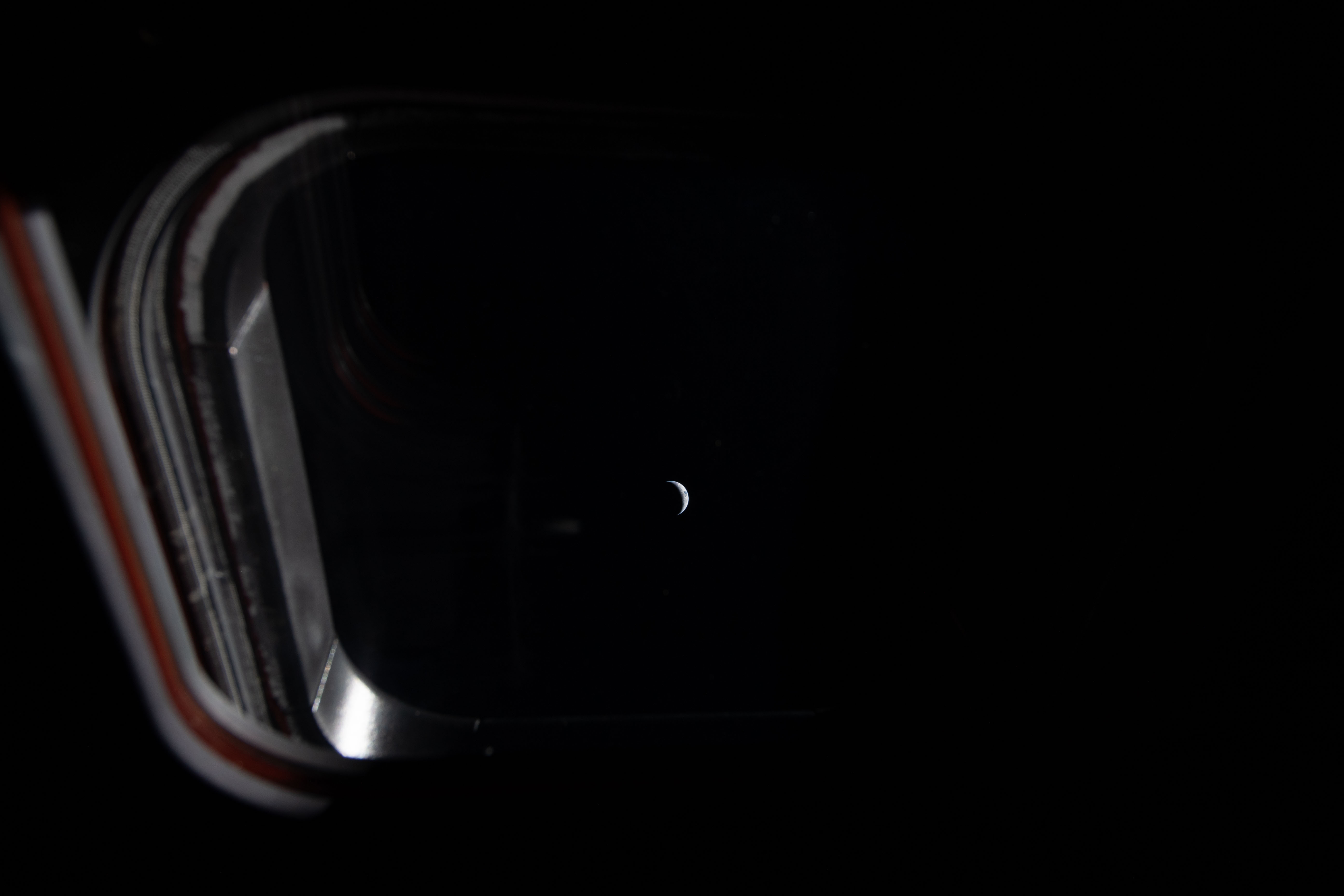
Meanwhile, the crew has already commenced observing and photographing the lunar surface in preparation for the flyby.
What is the Sphere of Influence and What’s Happening with Orion
The “sphere of influence” is not a visible boundary, but a conceptual region where a celestial body’s gravity becomes the primary force. For Artemis II, this means that from this point forward, the Moon’s gravity, rather than Earth’s, will predominantly govern the Orion capsule’s trajectory.
This entry is crucial as it marks the beginning of the most intricate phase of the lunar journey. The capsule’s trajectory is being precisely adjusted to harness lunar gravity and prepare for the flyby. Two previously planned corrective maneuvers for April 4 and 5, OTC-1 and OTC-2, were deemed unnecessary due to Orion’s already precise path. However, the 17.5-second corrective maneuver, OTC-3, was successfully executed at 5:03 AM Italian time this morning.
Currently, the astronauts are continuing to test the capsule’s systems, especially the life support systems, which are being operated with a crew in deep space for the very first time. Manual piloting tests have also been conducted to ensure Orion can be directly controlled by the astronauts if required.
Another significant activity involves inspecting the suits used during launch, re-entry, and emergency situations. The crew is also observing the lunar surface and pinpointing areas to be photographed during the flyby, contributing to valuable data collection for future missions.
The Lunar Flyby
The mission’s most anticipated moment will be the lunar flyby, during which Orion will pass behind the Moon, follow its curvature, and then begin its return journey towards Earth. The closest approach will be approximately 6,400 km from the lunar surface, a greater distance than Apollo missions, but still ample for observing the entire lunar disk, including its polar regions.
During this six-hour phase, the astronauts will observe the Moon both visually and using onboard cameras. The primary goals are to gather valuable images and information, as well as to validate operational procedures in authentic deep-space conditions. They will also be able to view approximately 20% of the Moon’s far side.
Should the mission proceed as planned, the crew will set a new record for the furthest human distance from Earth, surpassing that of the Apollo missions. The data collected will be pivotal for the subsequent phases of the Artemis program, particularly Artemis IV, which aims for astronauts to return to the lunar surface in 2028.