

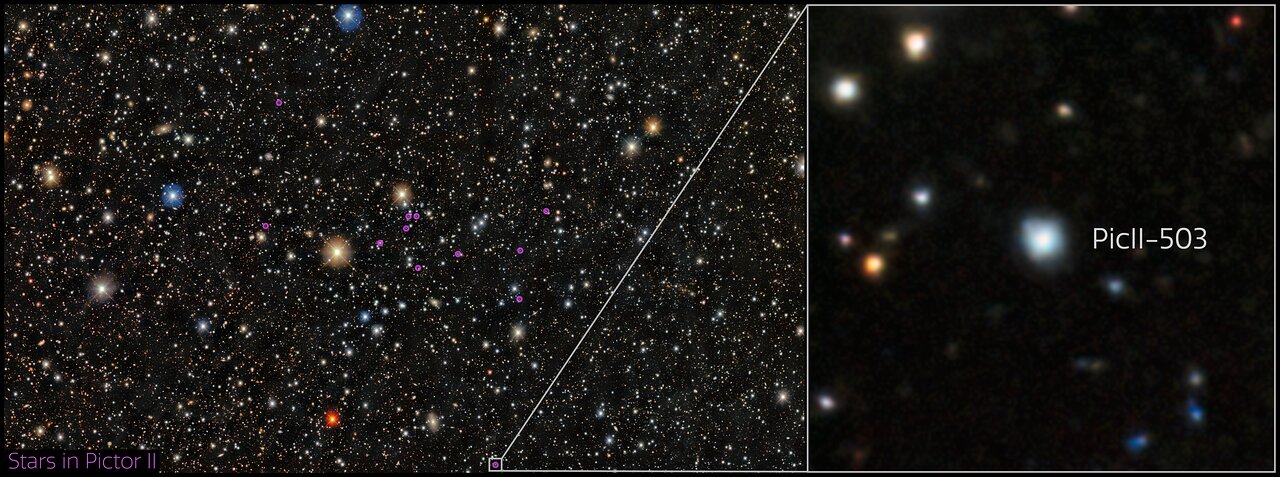
To reconstruct the early stages of the Universe’s life, astronomers meticulously study extremely primitive objects that retain traces of the first cosmic processes. Among these, certain stars serve as genuine ‘time capsules,’ capable of revealing how the first chemical elements were formed. A prime example is the star PicII-503, one of the most primitive ever observed. It was discovered within the ultra-faint dwarf galaxy Pictor II, approximately 150,000 light-years from Earth.
This star was identified using the Dark Energy Camera (DECam) on the Víctor M. Blanco Telescope in Chile, as part of the MAGIC survey, which aims to locate the oldest, metal-poor stars. PicII-503 contains an exceptionally low amount of iron – only 1/40,000th that of our Sun – making it the most iron-deficient star ever observed outside the Milky Way. Simultaneously, it exhibits an unusually high carbon content.
This unique combination establishes PicII-503 as one of the clearest examples to date of a second-generation star. Such stars form from the remnants of the Universe’s very first stars. These ‘Population III’ stars were composed almost entirely of hydrogen and helium, generating the first heavier elements through nuclear reactions within their cores.
When these primordial stars exploded as supernovae, they enriched the interstellar medium with newly forged elements. PicII-503 preserves the chemical fingerprints of this very process, providing astronomers with a rare chance to directly observe the effects of the cosmos’s earliest chemical evolution.
A Chemical Signature Revealing the First Stars
PicII-503’s chemical characteristics are what make it so significant. Beyond its extreme iron deficiency, the star displays a carbon-to-iron ratio more than 1500 times greater than that of the Sun. This specific chemical signature has been observed in some ancient stars located in the Milky Way’s outer halo, but their exact origin remained ambiguous.
PicII-503 now offers a direct clue: these stars might have formed in small, primordial dwarf galaxies, much like Pictor II, and were later assimilated into the Milky Way as it evolved. Furthermore, this discovery marks the first instance of a second-generation star found within an ultra-faint dwarf galaxy.
Astronomers theorize that this unusual carbon abundance results from low-energy supernova explosions. In such events, heavier elements like iron tend to fall back towards the core of the collapsing star, while lighter elements such as carbon are expelled into the surrounding space.
By analyzing the chemical composition of stars like PicII-503, it’s possible to reconstruct the mechanisms by which the first stars produced and distributed elements throughout the Universe. This approach, termed ‘cosmic archaeology,’ allows us to study epochs that would otherwise be inaccessible through direct observation.
The Role of Dwarf Galaxies in Cosmic History
PicII-503’s location within an ultra-faint dwarf galaxy is another point of considerable interest. Pictor II is a very small system, possessing limited mass and gravity, characteristics that influence its ability to retain elements produced by supernovae.
Had the explosions of the first stars been highly energetic, most chemical elements would have escaped the galaxy’s weak gravitational pull. The fact that PicII-503 exhibits such a specific composition, however, suggests that the supernovae involved were relatively low-energy, allowing the material to remain within the system and contribute to the formation of new stars.
This discovery was made possible by combining data from the MAGIC survey with more detailed observations from the Very Large Telescope and the Magellan/Baade Telescope. This integrated approach allowed for precise measurements of the star’s chemical abundances, confirming its extremely primitive nature.
PicII-503 thus provides direct evidence of the chemical enrichment processes in early galaxies. By studying similar objects, astronomers can better understand how the Universe transitioned from a simple composition, dominated by hydrogen and helium, to the more complex one we observe today. The upcoming Legacy Survey of Space and Time (LSST) from the Vera C. Rubin Observatory, set to begin in the coming months, will be invaluable in this endeavor.