

The well-known adage “History doesn’t repeat itself, but it rhymes” – popularly attributed to Mark Twain – inspires a new series of exhibitions at the Reina Sofía Museum. These displays will be presented alongside Picasso’s iconic Guernica, featuring works from diverse geographical and cultural contexts that share thematic or aesthetic resonances with the mural. The objective is to bring to light artistic scenes previously marginalized by traditional historiography.
The first chapter of this series focuses on the figure of South African artist Dumile Feni. Although his life was brief (born in the forties and passing in the nineties, not reaching fifty years of age), it was prolific enough to capture the harsh conditions of daily life under apartheid. His compositions, rich in myth and fantasy, draw from his cultural roots – the crafts, ceramics, and masks of his country – while also reflecting a cosmopolitan outlook.
Feni was a self-taught and compulsive draftsman, creating hundreds of works. Despite the racial segregation affecting Black artists, he immersed himself in Johannesburg’s vibrant creative scene in the 1960s, an effervescent period for jazz, theatre, and art galleries that, defying prohibitions, exhibited their creations.
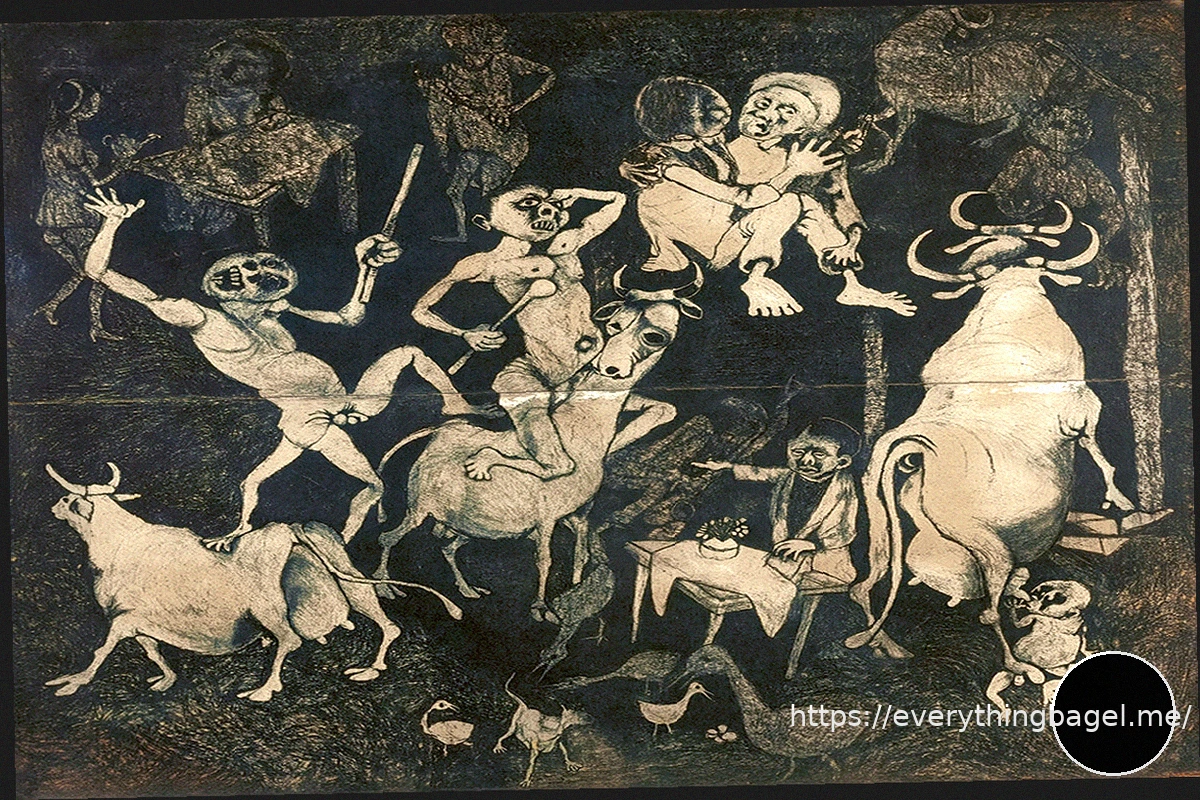
It was in this fertile environment that the central work of the new Reina Sofía exhibition, curated by Tamar Garb, emerged: African Guernica. First presented in 1967 at Gallery 101, the work was not titled by the artist himself, but it established a conscious and monumental dialogue with Picasso, whose work was widely known in South Africa through reproductions (as were Goya and Käthe Kollwitz). According to Garb, Feni used pencil and charcoal for a work of “history painting,” something uncommon at the time, while remaining true to his own cosmology.
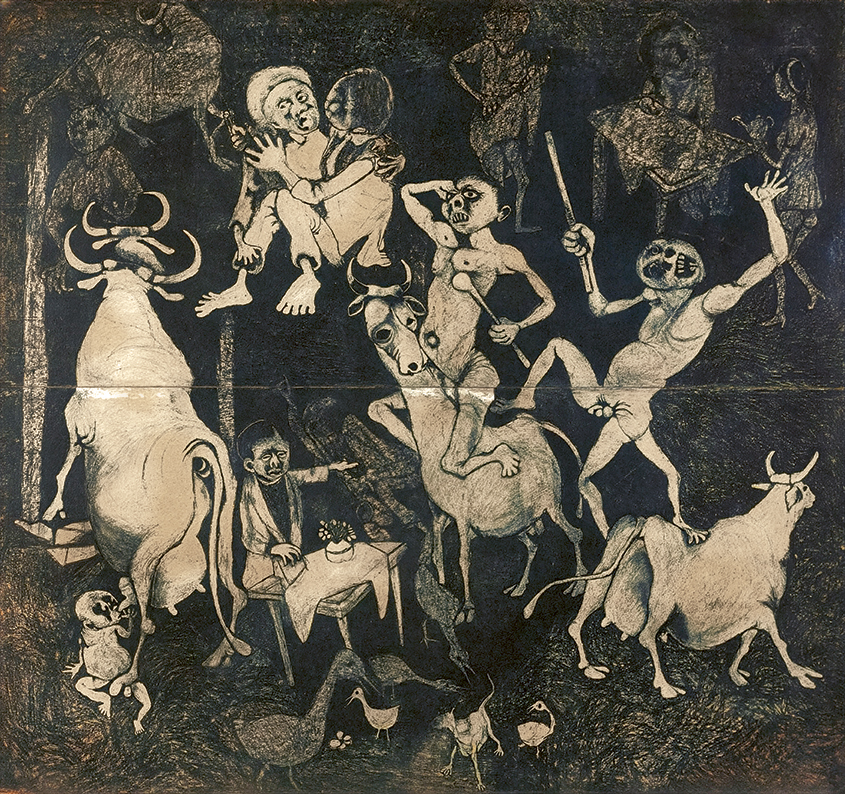
Dumile Feni. African Guernica, 1965. National Heritage and Cultural Studies Centre, University of Fort Hare. © Estate Dumile Feni and Dumile Feni Family Trust
It is widely recognized that Picasso’s career and many of his works, including Guernica, were profoundly influenced by his knowledge and collection of African sculpture. In this sense, Feni’s proposition in African Guernica, which pays homage to his own roots while also interpreting European influence (monochromatism, distortions, fragmentation), closes a historical circle by bringing both pieces face to face. Both works represent very distinct embodiments of modernity: Feni’s, moreover, challenged the expectation that Black artists should produce only “native art” or crafts for tourism.
Thematically, both compositions act as “anti-totalitarian totems,” responding to violent and dehumanizing situations, though of very different natures. Picasso’s Guernica emerged after a year of Civil War and became an anti-war emblem. Feni’s piece, in whose glass Guernica is unexpectedly reflected, does not allude to an open military conflict but to the quieter brutality of systemic racism, depicting a nightmare where hybrid figures interact with nature in disturbing ways.
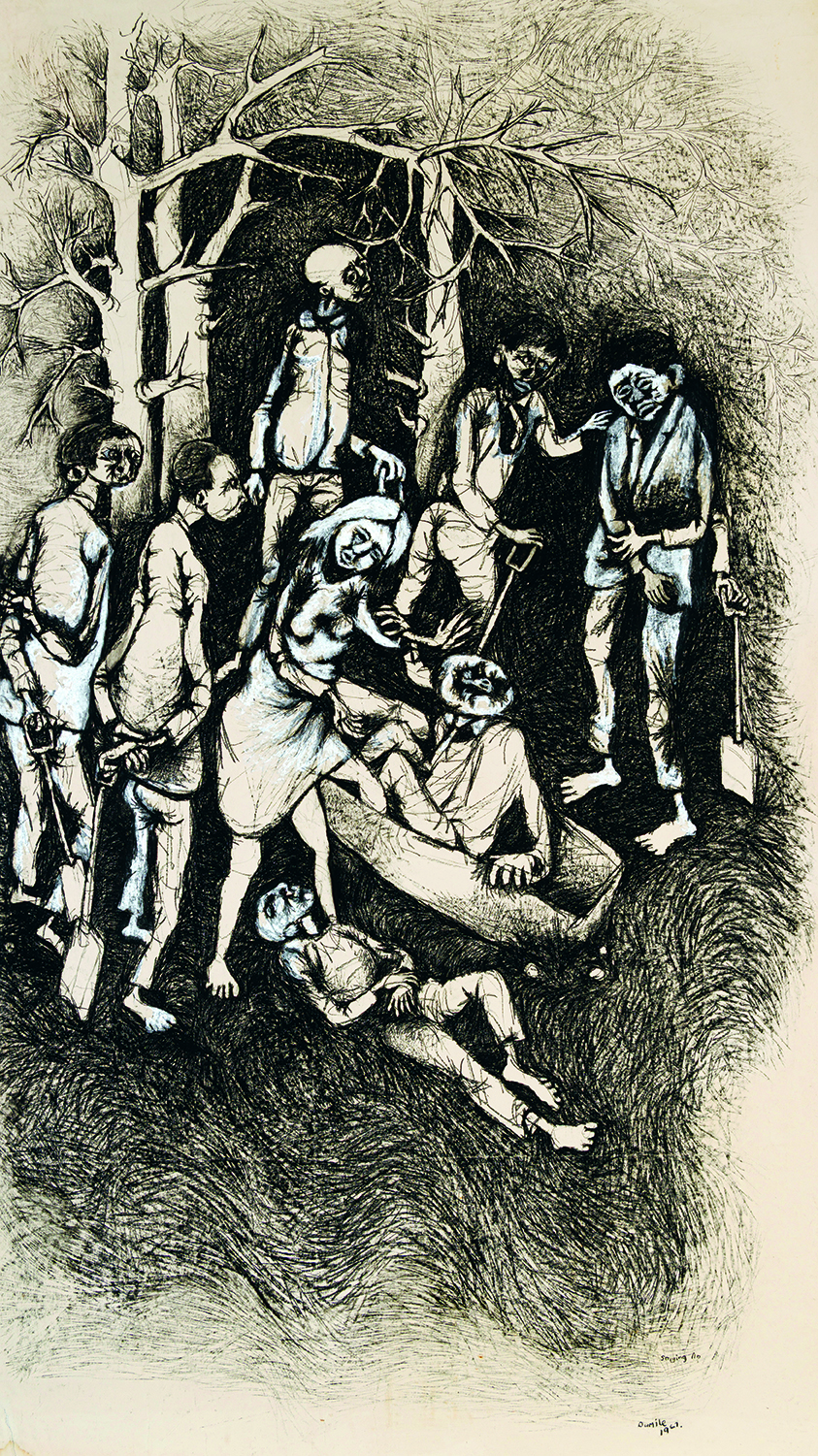
Dumile Feni. Saying no, 1967. © Estate Dumile Feni and Dumile Feni Family Trust
Alongside African Guernica, which is leaving South Africa for the first time, the MNCARS is exhibiting three monumental drawings also created in Johannesburg in the 1960s, and two others made during his exile in London and New York, the city where Feni died without being able to return to his country.
All these works come from South African collections. The three earliest pieces are The Classroom, Woman and Boy, and Saying No. In The Classroom, figures scattered across the paper seem to defy the norms of school segregation; in Woman and Boy, a woman resembling an ancestral statue holds a child as if he too were an archaic figurine; and Saying No embodies his refusal for his art to be categorized as “native art.”
During his time in London, Feni developed an extensive visual diary on a paper roll over fifty meters long. Part of this work is displayed in a showcase (the rest in video), offering a procession of fantastic creatures, names, and poetic references that reveal his worldview and daily practice. The final piece in the collection is Hector Pieterson (1987), a large-format charcoal work inspired by the photograph of the child murdered in 1976 during the Soweto uprising, where 176 people protesting against apartheid were massacred. Feni transformed the boy, carried in arms as in the Pietà of Guernica, into a symbol of brutally lost innocence.
Although Dumile Feni’s figure has been heavily politicized over the decades, he cannot be considered a “trench artist.” While he was interested in how art could serve society and confront oppression and censorship, his approach was primarily intellectual. He opposed the use of creation as propaganda and, as Garb has pointed out, the perception of artists as mere cultural workers.
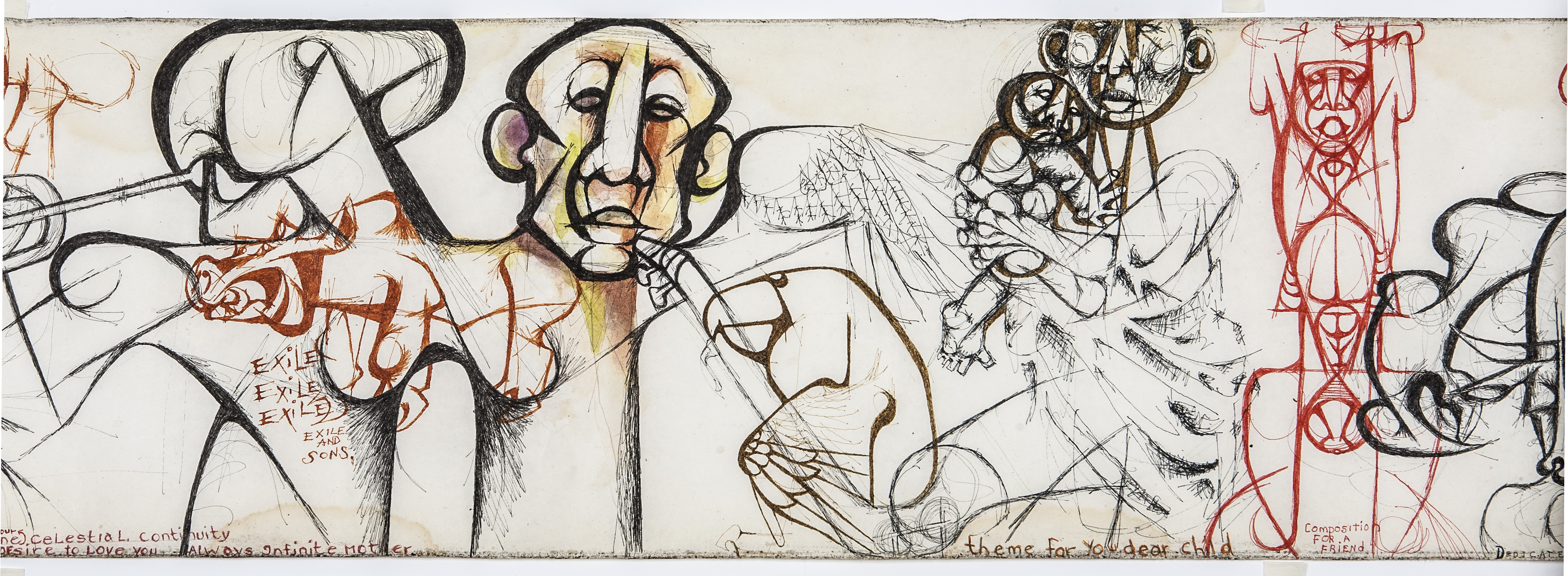
Dumile Feni. You Wouldn’t Know God if he Spat in your Eye (detail), 1975. Wits Art Museo Collection, Johannesburg. ©Estate Dumile Feni and Dumile Feni Family Trust