

NASA’s Artemis II mission officially marks humanity’s return to the Moon. For the first time in over fifty years since the Apollo program concluded, four astronauts will journey beyond Earth orbit, heading towards our satellite on a mission lasting approximately ten days.
This mission is a crewed test flight, not yet a lunar landing, designed to verify the performance of the Orion capsule and the Space Launch System (SLS) rocket under real deep-space flight conditions. Artemis II is an integral part of the wider Artemis program, which aims to establish a stable and continuous human presence on the Moon through the construction of a permanent lunar base.
The path to launch has been complex, involving several delays, but the mission is now set. Liftoff is scheduled for Wednesday, April 1st, at 6:24 PM Florida time (12:24 AM on April 2nd in Italy). This mission is a crucial moment for the entire program; its outcome will directly influence the timelines and technological choices for subsequent missions. This includes Artemis III, which has recently been reconfigured as another test mission, with humanity’s return to the lunar surface now planned for Artemis IV.
What Will Happen During This Mission?
The launch preparation sequence for Artemis II officially begins approximately 49 hours before the scheduled liftoff with the start of the countdown. During this phase, teams at various control centers are activated, and comprehensive checks of all SLS rocket and Orion capsule systems commence. About ten hours before launch, tanking will be authorized, filling the tanks with liquid oxygen and hydrogen. Four hours prior to liftoff, the astronauts will board the capsule.
In the final minutes, the rocket will switch to internal power and initiate the automated launch sequence. At T-0, the main RS-25 engines and solid rocket boosters (SRBs) will ignite, providing the majority of the initial thrust. Approximately two minutes later, the SRBs will separate, while the core stage will continue to fire until just over eight minutes after launch.
Once a suborbital trajectory is achieved, the ICPS upper stage will activate, propelling Orion into a highly elliptical Earth orbit. Approximately 50 minutes later, an initial burn will stabilize the orbit, followed by a second maneuver that will push the capsule to about 77,000 km from Earth.
After approximately three hours, Orion will separate from the second stage, initiating a phase of proximity maneuver tests. During this time, astronauts will manually control the capsule to verify its navigation and control systems. Once these tests are complete, Orion will definitively depart Earth orbit and prepare for the trans-lunar injection maneuver, which will occur about a day and a half after launch.
The chosen trajectory is a *free return* path, ensuring an automatic return to Earth in case of any issues. The journey to the Moon will take approximately four days, during which trajectory corrections will be performed. The lunar flyby will occur at a distance of 6,000 to 9,000 km from the surface, depending on the launch date and time.
After the flyby, Orion will use the Moon’s gravity to slingshot back towards Earth. Re-entry will occur after approximately nine days into the mission: the service module will separate, the capsule will re-enter the atmosphere protected by its heat shield, and then splash down in the ocean with the aid of parachutes, completing the mission.
The Crew
Aboard Artemis II will be four astronauts: Reid Wiseman, Victor Glover, Christina Koch, and Jeremy Hansen. This crew was selected to represent diverse experiences and skills, and also to reflect a significant shift from past missions.
Reid Wiseman, the mission commander, is a NASA astronaut with experience on the International Space Station (ISS). Alongside him is Victor Glover, the mission pilot, also a NASA astronaut and spaceflight veteran. Christina Koch, a mission specialist, has previously set the record for the longest single spaceflight by a woman. Jeremy Hansen, a Canadian astronaut, represents the international contribution from the Canadian Space Agency (CSA).
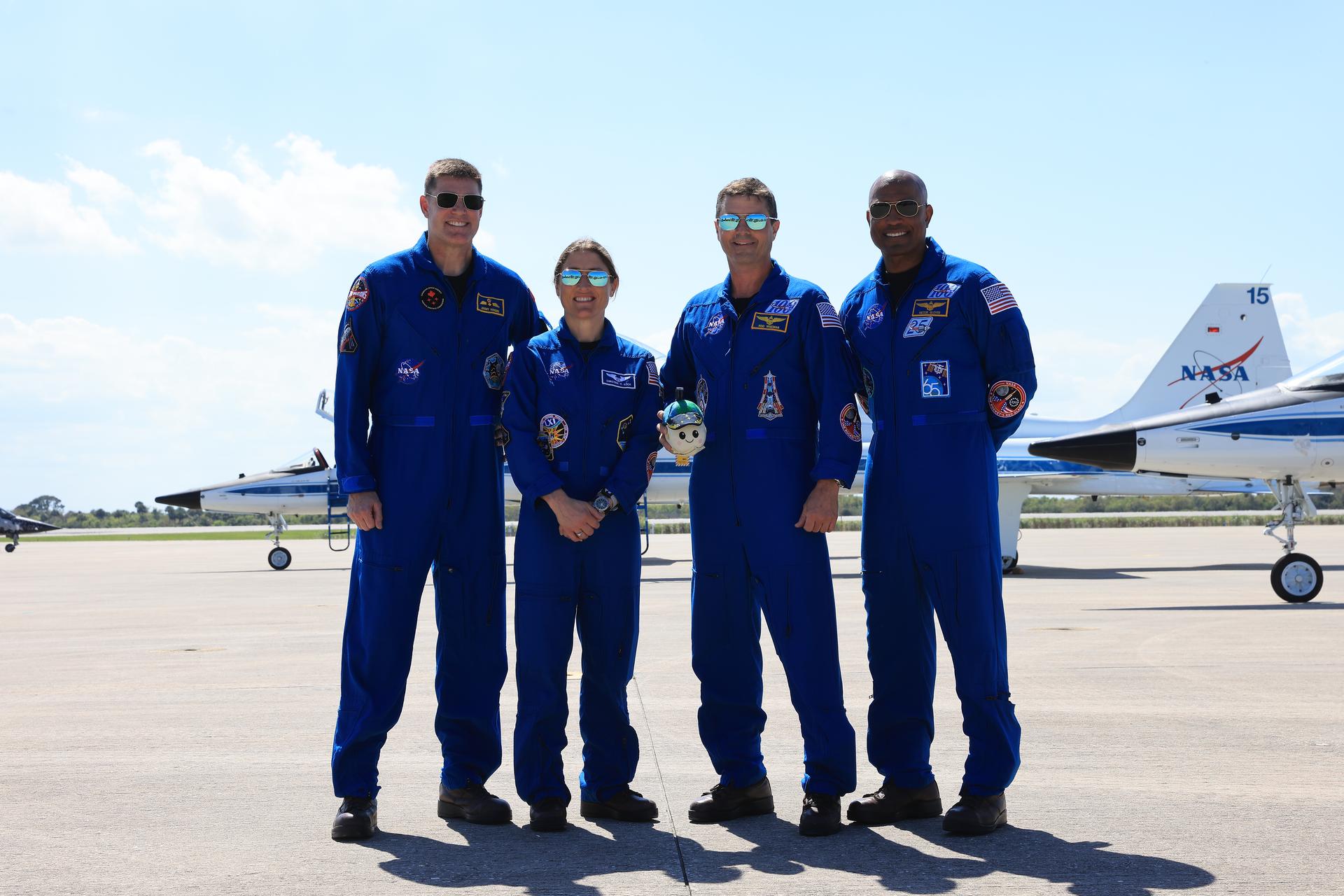
This crew will be the first, since Apollo, to travel beyond low-Earth orbit. Their primary role will be to test Orion’s systems under real conditions, verify operational procedures, and manage capsule maneuvers, including manual controls.
Beyond its technical aspects, the mission also holds symbolic value: it will be the first to include a woman and a non-U.S. astronaut on a flight to the Moon. This reflects the evolution of space exploration towards an increasingly international and inclusive context.
Accompanying them will be RISE, the Artemis II mission mascot, which will also serve as a zero-g indicator. When it is seen floating inside the capsule, the crew will know they are in microgravity conditions.
The Science of Artemis II
Although Artemis II is primarily a test mission, its scientific contribution is significant. Astronauts will be at the core of several experiments designed to study the effects of deep space on the human body.
Among these, ARCHeR will analyze sleep, stress, and cognitive performance using wearable devices. Meanwhile, “immune biomarker” studies will monitor the immune system, checking for changes caused by radiation and isolation.
A particularly innovative experiment is AVATAR, which uses microchips containing human cells to simulate tissue behavior in space. This allows for observation of microgravity and radiation effects on specific organs.
Astronauts will also be continuously monitored through the “Standard Measures” protocol, which collects data on physiological parameters before, during, and after the mission. Significant attention will also be given to radiation measurement, using onboard sensors and personal dosimeters.
During the lunar flyby, the crew will also have the opportunity to observe and photograph the Moon’s surface, contributing to the understanding of its geology and supporting the planning of future landing missions.
What if the Launch Isn’t on April 1st?
As with all space missions, the launch of Artemis II is constrained by precise temporal windows, determined by technical conditions, weather, and especially orbital mechanics. April 1st is the first available launch opportunity, following NASA’s decision not to use the February and March windows. However, it’s not the only one: in case of issues with the rocket, the Orion capsule, or unfavorable weather, NASA has already planned several alternative launch windows for subsequent days.
These windows are not continuous but distributed across specific intervals. This is because the chosen trajectory for Artemis II requires precise alignment between Earth and the Moon, which is necessary to ensure the Orion capsule’s automatic return to our planet without complex corrective maneuvers in an emergency, and also for the capsule’s proper functioning. Consequently, launching is not possible at any time.
Should the launch be postponed by one or more days, the mission would still maintain a very similar profile, with an overall duration of about ten days and the same operational phases. However, a longer postponement could lead to a delay to a subsequent window, potentially by several weeks, to re-establish the correct orbital conditions.
Currently, available dates range from April 1st to 6th (Florida evening/Italy night). A final possibility for this month is April 30th (May 1st in Italy). Subsequent dates have not yet been communicated by NASA.
The (Revolutionized) Future of the Artemis Program
In recent weeks, the future of the Artemis program has undergone profound changes. NASA announced a structural revision of its lunar strategy, pausing the Lunar Gateway (the lunar-orbiting space station) to focus resources, international partners, and private companies on building a stable presence directly on the Moon’s surface. The declared objective is more ambitious and concrete: to land astronauts on the Moon by 2028, begin construction of a permanent base by 2030, and deploy a first fission reactor to the lunar surface by the end of the decade.
The new plan will be developed in phases. Phase one will drastically increase the number of robotic missions and landers heading to the surface, including through the CLPS program, lunar rovers, and new vehicles like MoonFall Drones designed for short hops and terrain mapping. Phase two will introduce heavier infrastructure, power systems, telecommunications, and surface vehicles, with human missions scheduled every six months. Phase three will focus on continuous human presence on the Moon and the utilization of local resources such as water, oxygen, and hydrogen.
Subsequent Artemis missions have also been completely reprogrammed. Artemis III will be a low-Earth orbit test with one or two competing Human Landing System (HLS) landers, yet to be selected, in early 2027. Artemis IV and Artemis V will then be part of the new architecture designed to deliver the first elements of the lunar base. Thus, Artemis IV, not Artemis III, will be the mission that returns humanity to the Moon’s surface.
In this scenario, Artemis II remains a very important and decisive step: it must demonstrate that Orion and SLS can safely support the return of astronauts beyond Earth orbit, paving the way for an entirely new phase of lunar exploration.