

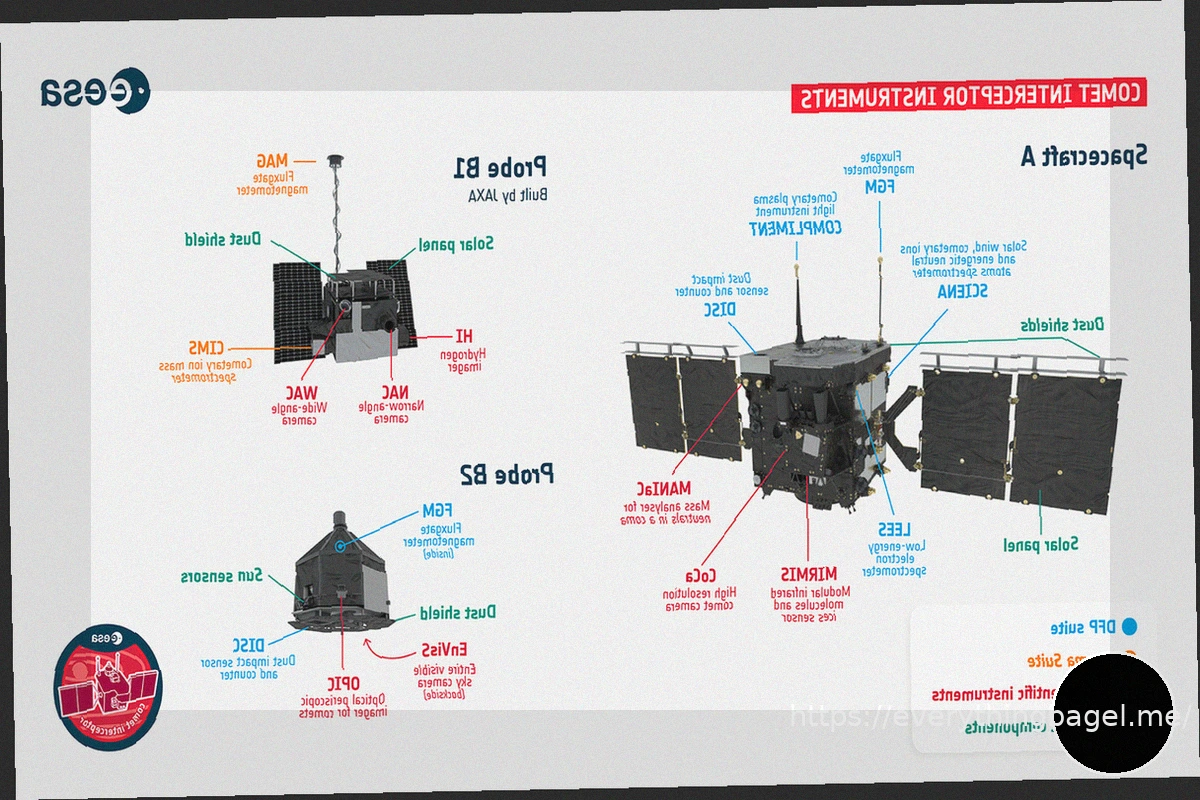
The initial instrument for the Comet Interceptor mission, an ESA project aiming to intercept an unknown comet or interstellar object from beyond our solar system, has been completed and delivered.
This instrument, named DFP-B2 (Dust, Fields and Plasma), was developed by the Space Research Centre of the Polish Academy of Sciences (CBK PAN) and handed over to the Spanish company Sener, which is responsible for integrating the B2 probe.
The system also features a significant Italian contribution. Among the sensors installed on DFP-B2 is Disc, an instrument designed to measure cometary dust particles, developed by Leonardo in Campi Bisenzio with support from the Italian Space Agency (ASI). The scientific responsibility for the sensor lies with the National Institute for Astrophysics (INAF), with Vincenzo Della Corte of INAF Naples serving as lead scientist.
The mission launch is scheduled for 2028 or 2029 aboard an Ariane 6 rocket. Once in space, Comet Interceptor will travel to the Sun-Earth Lagrange point L2, approximately 1.5 million kilometers from Earth, where it will await the discovery of a suitable target to intercept.
Three Probes to Observe a Comet from Different Vantage Points
Comet Interceptor will consist of three separate probes: a main vehicle, designated A, and two smaller probes, B1 and B2. During the comet’s flyby, the three vehicles will separate to conduct simultaneous observations from different points in the surrounding space.
The DFP instrument suite will be responsible for studying the dust, plasma, and magnetic fields within the cometary coma – the cloud of gas and particles that forms around a comet’s nucleus as it approaches the Sun. Concurrent measurements from the different probes will enable scientists to reconstruct the complete three-dimensional structure of the cometary environment for the first time.
One of the primary instruments will be Disc, the Italian sensor dedicated to analyzing the dust particles emitted by the comet’s nucleus. During the close flyby, the sensor will measure the mass and characteristics of individual particles intercepted by the probe.
These observations will help in better understanding the physical processes occurring on comet surfaces and how solar wind interacts with material expelled into space. The data may also offer insights into the conditions present during the formation of the Solar System.
However, the most distinctive aspect of the mission remains the selection of its target. Unlike traditional missions, Comet Interceptor will depart without knowing which object it will visit. Scientists are particularly hoping to intercept an interstellar object, similar to those observed passing through the Solar System at high speed in recent years.
European and Italian Roles in Instrument Development
The development of the DFP suite involves numerous European research institutes and companies. The overall coordination is managed by the Space Research Centre of the Polish Academy of Sciences, which is responsible for instrument integration, test campaigns, and operational management during the mission.
In addition to the Disc sensor, the system includes a magnetometer developed with contributions from Imperial College London, Iwf Graz, and TU Braunschweig, as well as a data processing unit created by the Institute of Atmospheric Physics in the Czech Republic.
Italy’s participation is particularly focused on activities related to the study of cometary dust. Besides INAF and Leonardo, the University of Naples Parthenope is also contributing, having worked on the theoretical and experimental calibration of measurements from the Disc sensor. These activities included simulations and laboratory tests to correctly interpret the data that will be obtained during the mission.
Following the delivery of the DFP-B2 instrument, the next step will be the completion of the second unit destined for the main vehicle A. This delivery is anticipated by July 2026, followed by integration into OHB facilities in Milan.