


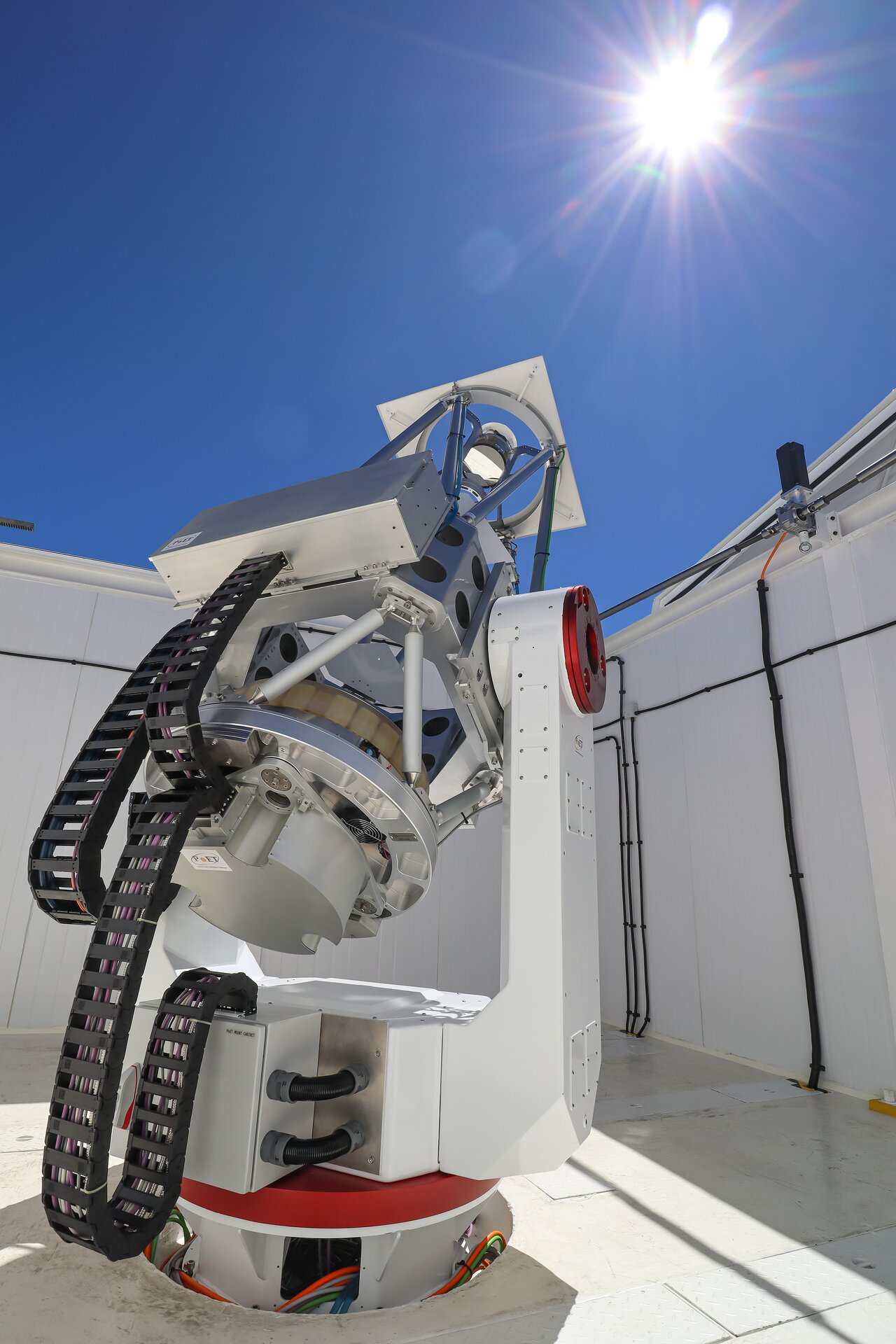
The PoET (Paranal solar ESPRESSO Telescope) solar telescope, installed at the European Southern Observatory’s (ESO) Paranal Observatory in Chile’s Atacama Desert, has conducted its initial observations. This milestone, known as first light, marks the commencement of the instrument’s operations, which is designed to study the Sun with a precise objective: to improve the search for planets outside our Solar System.
Exoplanets are discovered by observing starlight. Subtle variations in a star’s spectrum, which is its light dispersed into its constituent colors, can indicate the presence of an orbiting planet. However, the surface of stars is not static; phenomena like sunspots, flares, and other events can alter the emitted light. These changes create “noise” that makes it harder to determine if an observed signal is genuinely caused by a planet.
PoET was developed to help distinguish these effects. Instead of directly studying distant stars, the telescope observes the Sun, our closest and best-understood star. By analyzing how solar activity modifies its light, astronomers can learn to recognize and correct for these same effects when observing other stars.
The first observations, carried out in early April 2026, have demonstrated the system’s proper functioning. PoET is capable of collecting data on both the entire solar disk and specific regions of its surface. Following a testing and optimization phase, scientific observations will commence.
PoET: Studying the Sun to Search for Distant Worlds
PoET is engineered for highly precise solar observation. Its main telescope, equipped with a 60-centimeter mirror, can analyze specific areas such as sunspots. A second, smaller telescope observes the entire solar disk simultaneously.
This dual approach allows for a comparison between events in localized regions and the star’s overall signal. This, in turn, provides a better understanding of how surface phenomena influence the light we observe from afar.
The collected data is analyzed using ESPRESSO, a highly accurate spectrograph installed on the Very Large Telescope (VLT). At night, ESPRESSO searches for exoplanets in distant stars. During the day, thanks to PoET, it is utilized to study the Sun. This continuous utilization of the instrument allows for a direct correlation between solar and stellar observations.
A Step Forward in Finding New Planets
PoET was developed in Portugal with support from the European Research Council, and contributions from Italy and Chile for the construction of certain components. The telescope is remotely managed by the Astrophysics Center of the University of Porto.
Initial tests have confirmed that the instrument is performing as expected. In the coming weeks, it will undergo further calibration before entering its operational phase. The data collected will then be made available to the scientific community through the ESO archive.
The goal is to enhance the reliability of exoplanet detection, particularly for small, Earth-like planets. A deeper understanding of the Sun’s behavior will enable more precise interpretation of light from other stars, thereby increasing the chances of identifying new worlds hidden within data noise.