


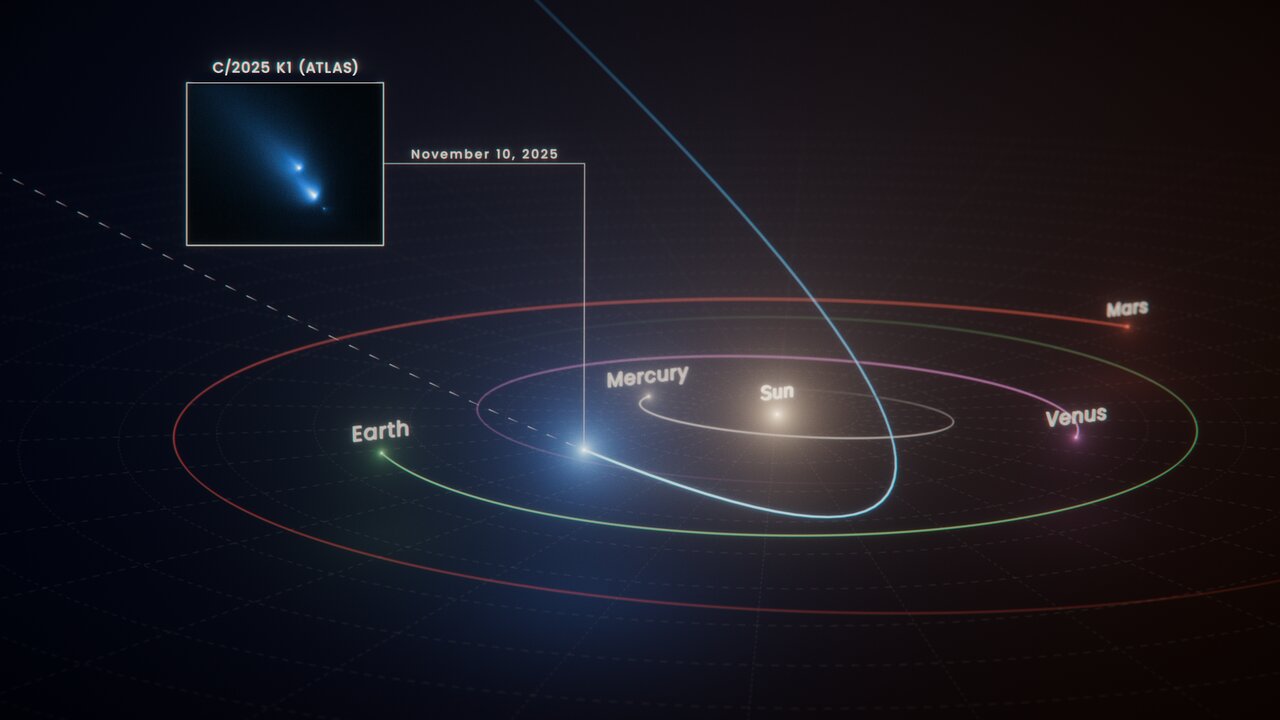
The Hubble Space Telescope has captured a truly rare phenomenon: a comet breaking apart into multiple fragments. This particular comet, designated C/2025 K1 (ATLAS), had recently passed its perihelion – the closest point in its orbit to the Sun. Consequently, it was already on its outward journey from the Solar System when this spectacular fragmentation occurred.
Just days prior, the comet appeared intact. However, subsequent observations revealed it had fragmented into at least four distinct pieces. Remarkably, each of these fragments had developed its own coma, a unique cloud of gas and dust surrounding it.
What makes this observation particularly astonishing is its accidental nature. Scientists weren’t specifically targeting Comet K1. Their primary observational target was no longer visible, so they selected K1 as an alternative. It was precisely at this serendipitous moment that the comet began to disintegrate, making the discovery incredibly fortunate.
Researchers only realized the full extent of the event the following day upon reviewing the images. Instead of a single comet, they discovered four separate objects. Such fragmentation events are notoriously challenging to witness, as they unfold rapidly and often without prior warning signs.

What Does This Fragmentation Reveal About Comets?
Comets are ancient celestial bodies, having formed billions of years ago alongside our Solar System. As such, they contain primordial materials that are invaluable for understanding the early stages of our cosmic neighborhood. Their surfaces, however, are not static; solar heat and radiation constantly alter their outer layers. When a comet fragments, it exposes its interior parts, which are likely to have remained in a more “original” or pristine state.
In the instance of Comet K1, Hubble’s superior resolution allowed for a clear view of the separated fragments. This level of detail is typically unattainable with ground-based telescopes, which often resolve such events as mere indistinct smudges.
The images were taken approximately one month after the comet’s perihelion. During this period, Comet K1 had experienced extremely high temperatures, having passed even closer to the Sun than the planet Mercury. This intense thermal stress is a likely cause of its disintegration.
Scientists hypothesize that the comet began to fracture roughly eight days prior to these observations. Over this period, the pieces progressively drifted apart, with one of the initial fragments further breaking down.
Behavior Still Puzzling Scientists
However, one detail remains enigmatic. Typically, when a comet breaks apart and exposes fresh ice, an immediate surge in brightness is expected. In this particular case, such an increase was not observed right away.
One plausible explanation involves dust. A comet’s luminosity is primarily driven by the dust particles that reflect sunlight. Exposed ice alone might not be sufficiently reflective. It’s possible that a certain amount of time is required for a dust layer to form and then be expelled, contributing to increased brightness.
Another hypothesis suggests that heat must penetrate deeper beneath the comet’s surface. Only then would sufficient pressure build up to visibly eject gas and dust. This observation is highly valuable as it indicates a potential delay between the actual fragmentation event and its observable changes in brightness or appearance.
Analysis of the comet’s behavior is still ongoing. Initial data suggests that this comet differs from others observed, containing less carbon than typically expected. Further in-depth studies will be crucial to gain a more comprehensive understanding of its unique composition.
The fragments of Comet C/2025 K1 (ATLAS) are currently approximately 400 million kilometers from Earth and are continuing their outward journey from the Sun. They are following a trajectory that will likely lead them beyond the confines of our Solar System, with little chance of ever returning.
The abstract of the study presenting these findings is available for review.