

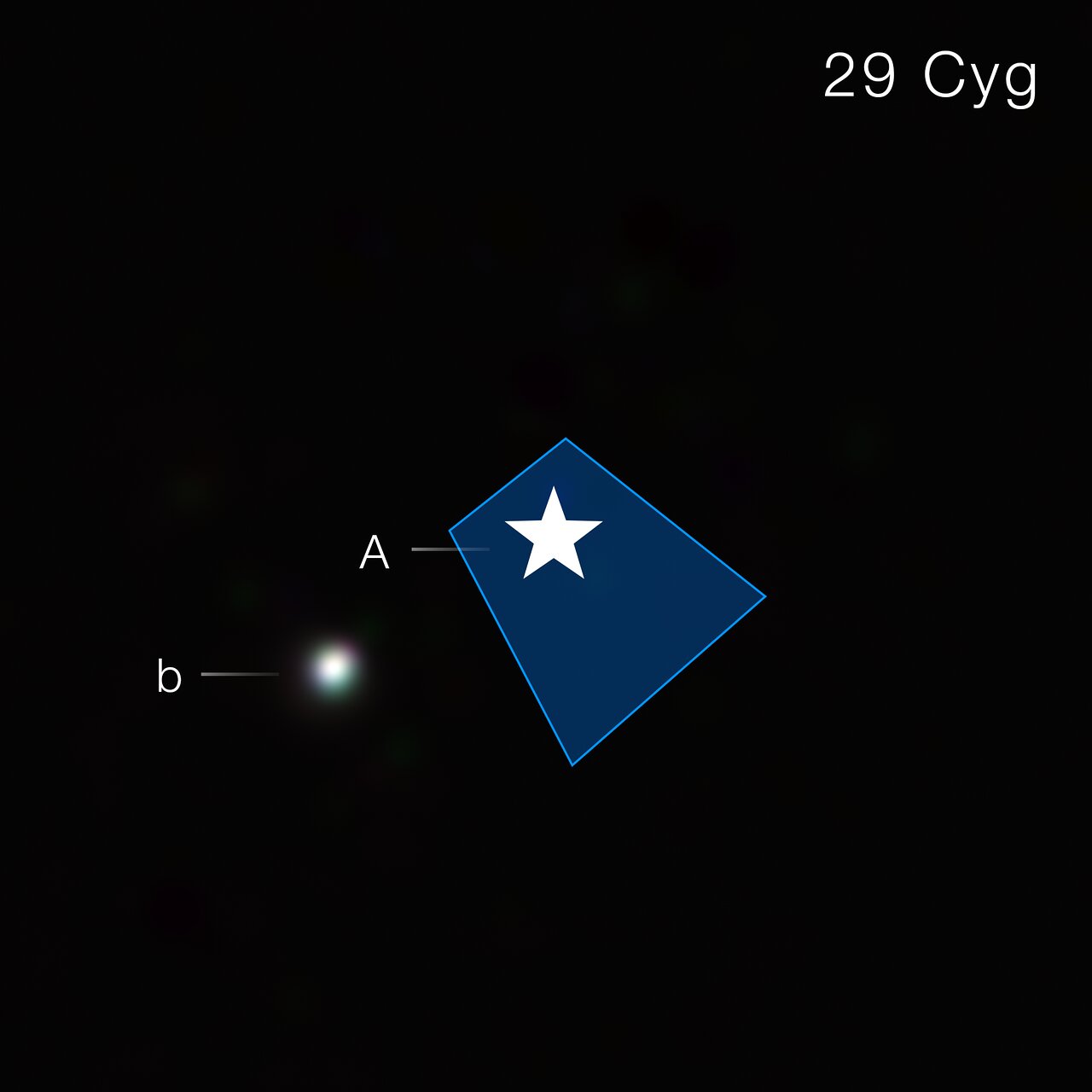
Recent observations by the James Webb Space Telescope have shed light on an object that occupies the intermediate zone between planets and stars, providing crucial insights into the formation of more massive bodies within planetary systems. This object is 29 Cygni b, with a mass approximately 15 times that of Jupiter, orbiting a Sun-like star at a distance comparable to Uranus in our Solar System (about 2.4 billion km).
Traditionally, planets and stars are distinguished by their formation processes. Planets form within disks of gas and dust surrounding young stars through a gradual process of accretion. Stars, on the other hand, are born from the direct collapse of large gas clouds. However, very massive objects like 29 Cygni b can theoretically form through either mechanism, making classification difficult.
Webb’s observations have provided more evidence to understand which of these two mechanisms gave rise to this object. The results indicate that 29 Cygni b formed through accretion, like a planet, rather than through the direct collapse typical of stars.
A Massive Planet Born from a Protoplanetary Disk
The observations were made using Webb’s NIRCam instrument in coronagraphic mode, which allows the blocking of starlight to directly observe faint objects in its vicinity. 29 Cygni b is one of four objects selected for this program, all with masses between 1 and 15 times that of Jupiter and still warm after their formation.
The analysis focused on the planet’s atmospheric composition, specifically the presence of molecules like carbon dioxide (CO₂) and carbon monoxide (CO). These compounds allow for the estimation of the abundance of heavy elements, referred to as “metals” in astronomy. The data show that 29 Cygni b is metal-enriched compared to its host star.
This characteristic suggests that the planet accumulated large amounts of solid material rich in heavy elements within a protoplanetary disk. In total, the quantity of these elements is equivalent to about 150 Earth masses. This value would be consistent with the accretion process, where small dust grains gradually aggregate to form increasingly larger bodies.
Aligned Orbit Confirms Planetary Origin
A second key piece of evidence concerns the orbit of 29 Cygni b. Researchers also used the ground-based CHARA array to determine the orientation of its orbit relative to the star’s rotation axis. The results show that the two are aligned.
This configuration is typical of planets that form within a protoplanetary disk, where all material rotates in the same plane. If the object had formed through gravitational fragmentation, as happens with stars, a different inclination would be more likely to be observed.
By combining information on composition and orbit, the study concludes that 29 Cygni b formed through rapid accretion of metal-rich material. Therefore, despite its high mass, its origin is consistent with that of giant planets.
The observational program will now continue with three other similar objects. Comparing planets of different masses should help clarify how the formation process changes with increasing mass, contributing to a better definition of the boundary between planets and stars.
The study, published in The Astrophysical Journal Letters, can be accessed here.