

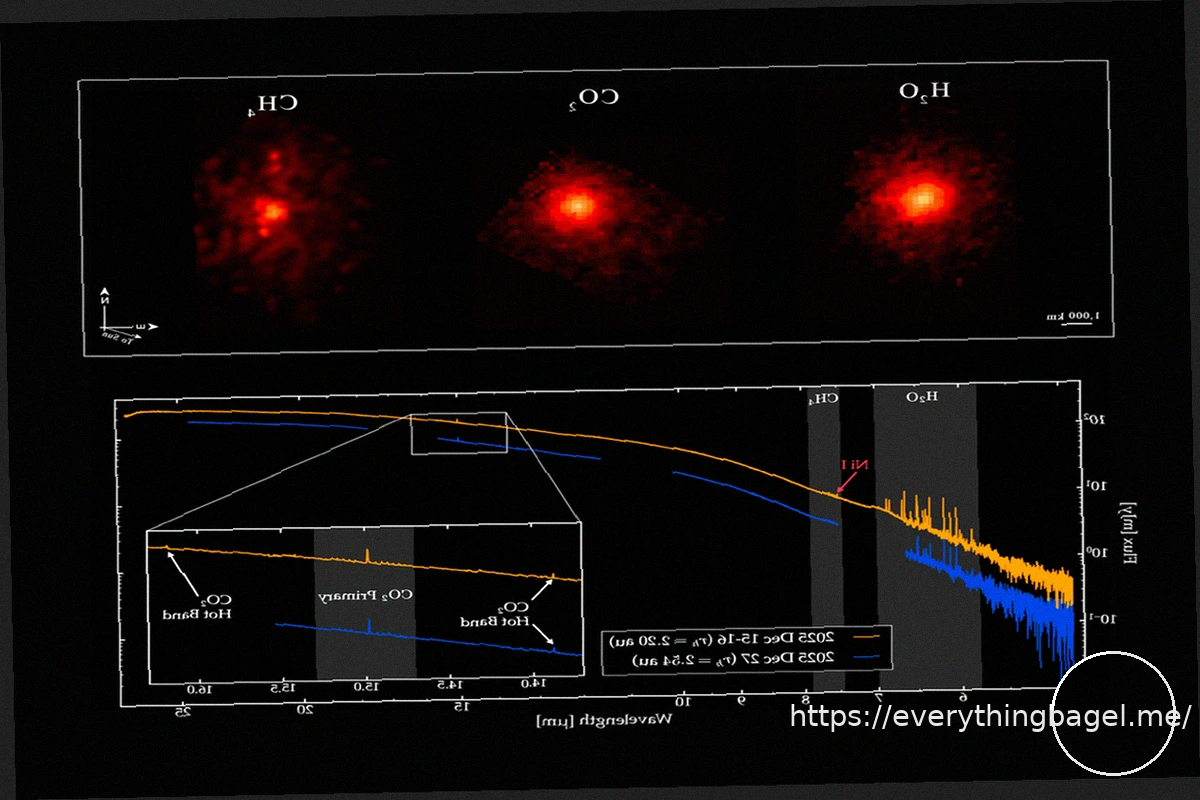
The James Webb Space Telescope (JWST) has captured the first mid-infrared observations of the interstellar object, comet 3I/ATLAS. This data has allowed astronomers to conduct a detailed study of its chemical composition, marking the first detection of methane in a visitor from another star system.
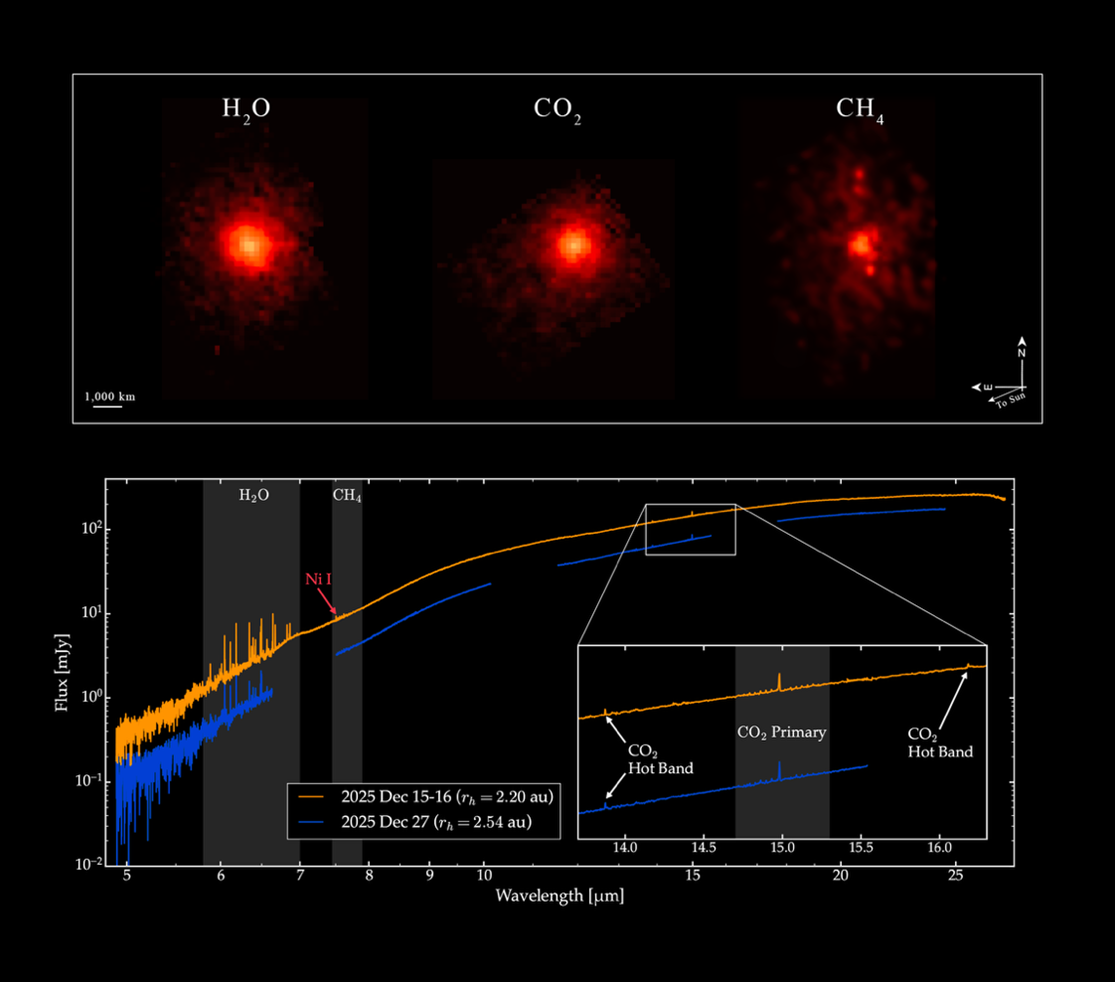
These observations were made using the Mid-Infrared Instrument (MIRI) on two separate occasions after the comet passed near the Sun. The first observation session took place between December 15-16, 2025, when 3I/ATLAS was approximately 329 million km from the Sun. The second session on December 27 saw the comet at about 379 million km from our star. By analyzing the infrared light emitted by the gases surrounding the nucleus, the team obtained the most detailed chemical study ever conducted on an interstellar object.
A key finding from these observations is the discovery of methane, a molecule that had not been detected in previous analyses of the comet or in other known interstellar objects. The data suggests that methane-containing ice was hidden beneath the comet’s surface, and only reached by the Sun’s heat after its perihelion passage. Webb also confirmed that 3I/ATLAS is particularly rich in carbon dioxide compared to water, a characteristic that is rare among Solar System comets.
The measurements indicate that 3I/ATLAS appears to have formed in an environment vastly different from the one that gave rise to most comets within our Solar System.
A Comet Unlike Those in Our Solar System
Webb’s observations also revealed how 3I/ATLAS’s activity changed after its close approach to the Sun. Between the two observation sessions, separated by about two weeks, astronomers recorded a decrease in the amount of gas emitted by the comet. The most noticeable drop was in water vapor, which tends to diminish rapidly as an icy body moves away from the Sun and receives less energy.
Methane and carbon dioxide, however, continue to sublimate even at lower temperatures. This behavior helps astronomers reconstruct the comet’s internal structure and understand how different ices are distributed within it. Specifically, the fact that methane was only observed after perihelion suggests that some of this material was hidden beneath the surface, protected by the outer layers of the nucleus.
The combination of a high abundance of methane and an unusually large amount of carbon dioxide makes 3I/ATLAS a very different object from most comets studied in the Solar System. While a few cases with similar characteristics exist, none represent a direct comparison. For researchers, this composition could reflect the conditions present in the protoplanetary disk of the star around which the comet formed billions of years ago.
This is precisely why interstellar objects are so important: they carry information about distant planetary systems that cannot be studied in any other way. With its mid-infrared observations, Webb has demonstrated its capability to analyze these rare visitors in detail. This opens up a new avenue for comparing the chemistry of Solar System comets with that of objects formed around other stars.
The study containing these results has been published in The Astrophysical Journal Letters.