

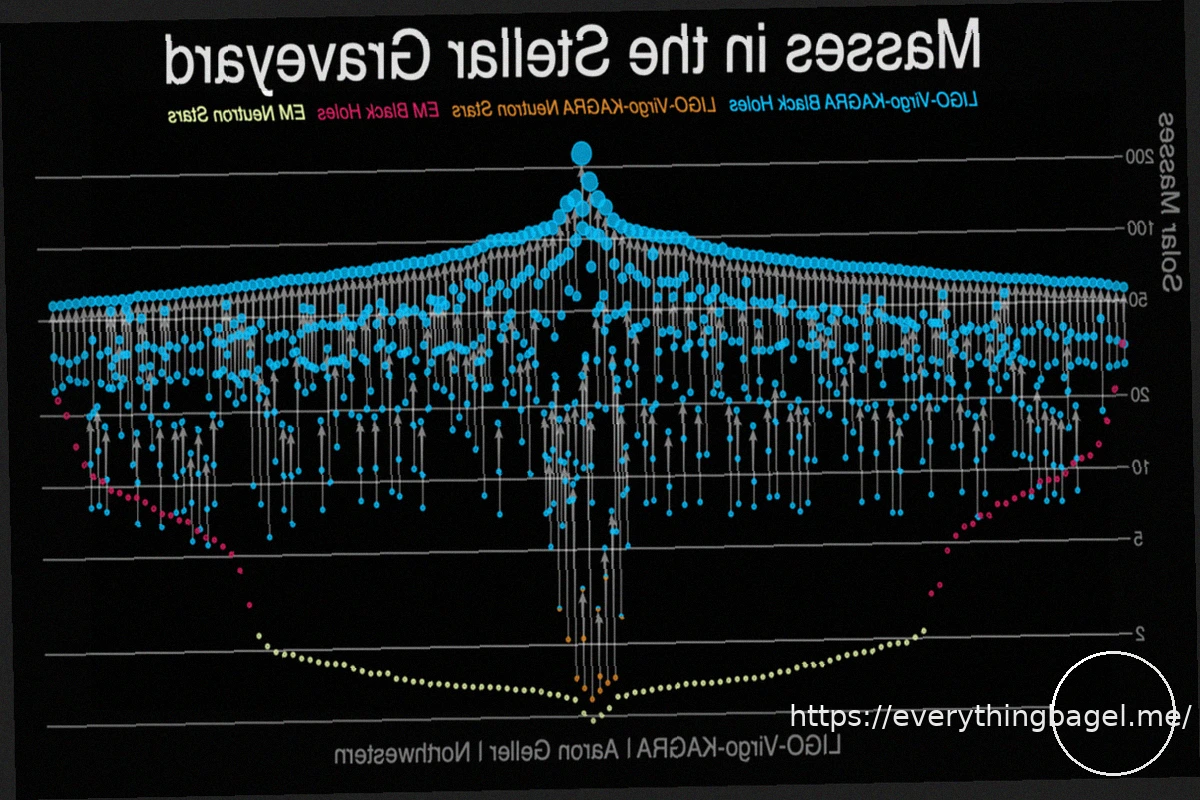
The international LIGO-Virgo-KAGRA (LVK) collaboration has unveiled an updated catalog of observed gravitational wave events. Titled the Gravitational Wave Transient Catalog-5.0 (GWTC-5.0), this document compiles all events detected from the groundbreaking observation in 2015 up to January 2025, bringing the total to 390 confirmed signals. A significant portion, 161 new events, were identified during the latter part of the fourth observing run, known as O4b.
These data originate from the two LIGO (Laser Interferometer Gravitational-wave Observatory) interferometers in the United States, the Virgo detector in Italy, and Japan’s KAGRA (KAmioka GRAvitational wave) detector. Collectively, these instruments form a global network capable of measuring minute distortions in spacetime caused by extreme cosmic phenomena, such as the mergers of black holes or neutron stars.
The new catalog represents a significant advancement for gravitational wave astronomy. With nearly 400 events now available, scientists can study black hole populations on a large scale and test general relativity with unprecedented precision. The fourth observing run alone accounts for approximately 75% of all events observed since 2015, a remarkable achievement attributed to continuous technical improvements in the detectors and promising for future observations.
The catalog also features several exceptional events. Among these are the most precise localization ever achieved for a gravitational wave source, the clearest signal ever recorded, and new evidence for the existence of second-generation black holes – objects formed from prior mergers.
Most Precisely Localized Signal
One of the standout events in the new catalog is GW240615, observed on June 15, 2024. This signal was detected simultaneously by both LIGO and Virgo, enabling scientists to pinpoint the source with record-breaking accuracy. The uncertainty region in the sky was reduced to approximately 6 square degrees, the best result ever obtained in gravitational wave astronomy.
This event resulted from the merger of two black holes with masses around 26 and 30 times that of the Sun, occurring over 3 billion light-years from Earth. Such precise localization is crucial because it allows traditional telescopes to search for associated signals, like light or gamma-ray emissions. This approach, known as multi-messenger astronomy, combines information from various observational types to study cosmic events more comprehensively.
This breakthrough was made possible by Virgo’s return to operation in April 2024, following a period of technical upgrades. Having three detectors active simultaneously allows for triangulating source positions with significantly higher accuracy than is possible with only two instruments.
The increased precision in measurements is also helping astronomers refine estimates of the Hubble constant, the parameter describing the expansion rate of the Universe. Its precise value remains a key point of contention in modern cosmology.
Second-Generation Black Holes and Increasingly Clearer Signals
Among the events included in the catalog is GW250114, the clearest gravitational wave signal ever observed. Its signal-to-noise ratio reached a record 76.9, allowing scientists to analyze the phenomenon with unparalleled detail.
This signal was generated by the merger of two black holes with very similar masses, approximately 32 and 34 solar masses, occurring over a billion light-years from Earth. The exceptional data quality has already enabled the LVK Collaboration to perform the most accurate test of general relativity to date and to confirm Stephen Hawking’s black hole area theorem.
The new catalog also provides further evidence for the existence of so-called second-generation black holes. Events GW241011 and GW241110 exhibit characteristics consistent with objects born from previous mergers. Notably, scientists observed unusual properties in the spin of the involved black holes, referring to the speed and orientation of their rotation.
These systems may form in dense environments, such as stellar clusters, where black hole collisions can occur multiple times. With the growing number of observed events, researchers are beginning to distinguish different black hole populations and gain a better understanding of how these objects form and evolve in the Universe.
The fourth observing run is not yet fully analyzed. The final release of O4 data is expected by December 2026 and could further increase the total number of observed events.