

New data from NASA’s Curiosity rover suggests that certain areas of Mars’ subsurface may have maintained conditions and temperatures favorable for liquid water for millions of years, despite the planet’s overall cooling. The study, published in the journal Science, identifies hematite as a new mineralogical indicator capable of reconstructing the climatic evolution of ancient Mars.
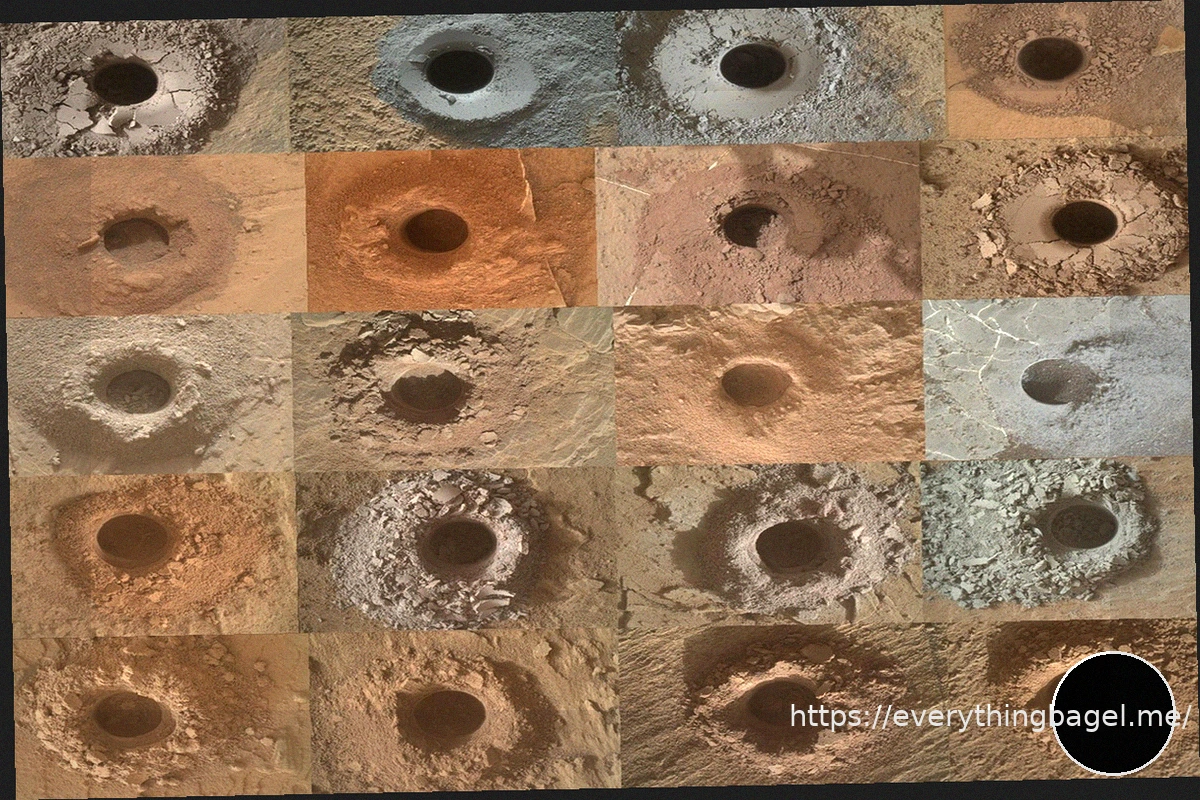
Researchers analyzed 20 rock samples collected by Curiosity at various altitudes within Gale Crater, the site the rover has been exploring since 2012. This large impact basin preserves a long sequence of rock layers that record the planet’s environmental history, from epochs when lakes and rivers were present on the surface to the more arid conditions observed today.
Using data from the CheMin instrument, designed to identify the mineral composition of Martian rocks, the team discovered that hematite crystal sizes vary depending on the depth of the analyzed layers. In the upper layers, the crystals are very small, less than 10 nanometers. In the deeper layers, however, they reach sizes up to 65 nanometers. Researchers also observed the presence of the mineral goethite in the upper layers and its absence in the lower ones.
These differences provide clues about the environmental conditions under which the minerals formed and transformed over time. According to the authors, the results indicate that relatively warm and stable aquifers were present in the subsurface of Gale Crater, capable of persisting for very long periods even as Mars’ global climate progressively became colder and drier.
A Mineral Archive of Martian Climatic History
Hematite has long been considered one of the most important pieces of evidence for water-rock interaction on Mars. However, this study shows that the mineral can provide even more detailed information: the shape and size of its crystals preserve a record of the environmental conditions present during their formation.
The researchers interpreted the results by examining the ratio between hematite and goethite, two iron-rich minerals that often form together in the presence of water. Under relatively cold conditions, goethite can remain stable. However, when temperatures rise and water maintains a neutral or slightly alkaline pH, goethite tends to transform into hematite.
The same warm and humid environment also favors a process called Ostwald ripening, where smaller crystals gradually dissolve, allowing larger ones to grow. The presence of more developed hematite crystals in the deeper layers thus suggests that these rocks have been in contact with warm water for very long periods.
According to the study’s authors, the data indicates that such conditions could have lasted for up to approximately 4.7 million years. This is a significant timescale, especially considering that the planet was already undergoing a phase of climatic cooling. Even after the disappearance of surface lakes and rivers, the subsurface could therefore have continued to offer relatively stable, and potentially habitable, environments.