

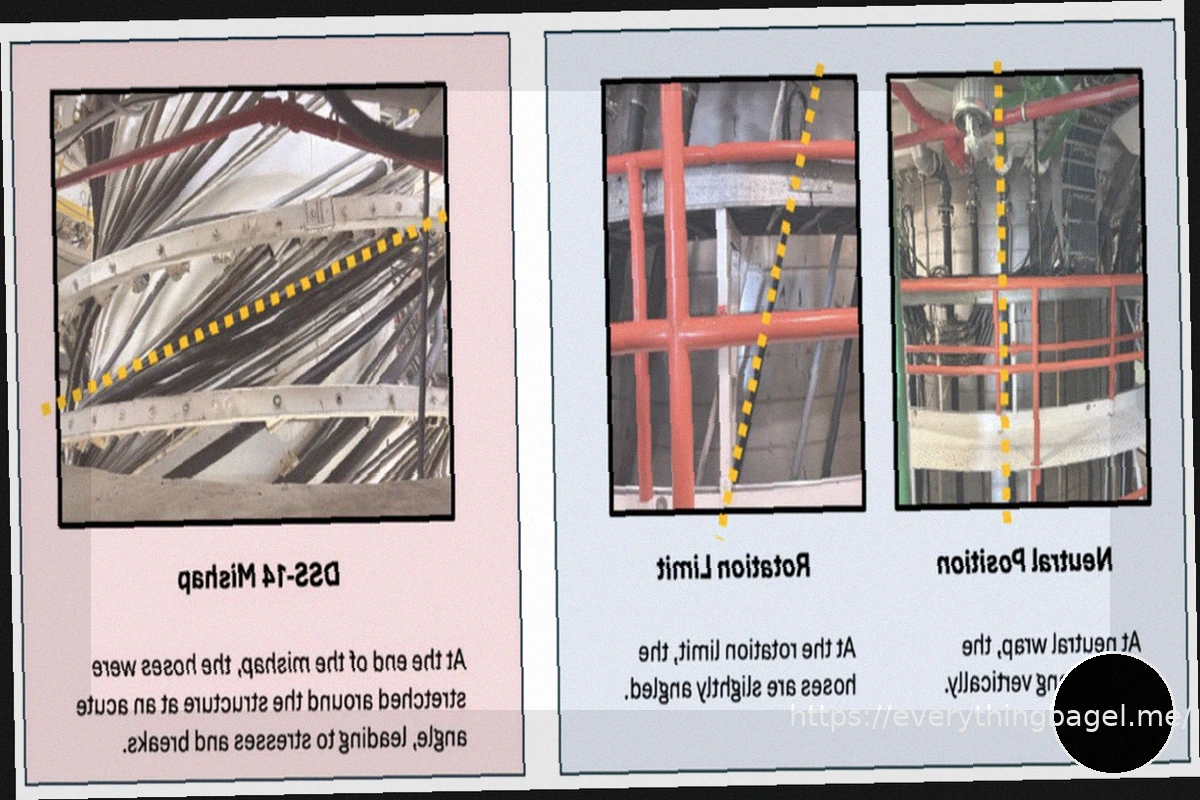
NASA has concluded its investigation into the incident on September 16, 2025, that rendered the DSS-14, the largest antenna of the Deep Space Network (DSN), inoperable. The DSN is the global network used by the Agency for deep space mission communications. The final report attributes the event to a combination of software issues, human errors, and the failure of a mechanical safety system.
The incident occurred while the 70-meter antenna at the Goldstone complex in California was tracking the Juno probe orbiting Jupiter. During operations, the structure exceeded its intended rotation limits, subjecting cables and supports to severe stress. The anomalous movement also damaged some fire suppression system pipes, leading to flooding within the structure. Fortunately, no one was injured.
According to investigators, the previous day, an electrical problem caused an incorrect reading of the antenna’s position by the control system. This anomaly went undetected, and during the tracking of Juno, it triggered several automatic safety shutdowns. In an attempt to resolve the issue, operators performed a series of procedures that bypassed some software and hardware protections, ultimately allowing the antenna to rotate beyond its permitted limits.
NASA has classified the event as a Type A Mishap, the most serious category of incident. Repairs are estimated to cost between $4.1 and $4.6 million. The DSS-14 will remain offline during these repairs and for its already scheduled maintenance and upgrade program, which is expected to conclude in 2028.
The Last Safety Barrier Was Non-Operational
The investigation also highlighted a more serious issue: the hydraulic system, which served as the final mechanical safeguard against over-rotation, was not operational at the time of the incident. According to the report, the system had been damaged in a previous, improperly documented incident and had not undergone adequate testing for an undetermined period.
After detecting the flooding at the base of the antenna, operators attempted to move the structure to a safe configuration. However, because the antenna had already exceeded its rotation limits, this maneuver further exacerbated the situation, causing additional damage.
The report also noted deficiencies in operational procedures, an over-reliance on undocumented practices, and gaps in the antenna’s control logic. It emphasized that at the Goldstone site, there was a work culture that encouraged operators to keep the system operational as much as possible, sometimes taking on responsibilities beyond their expertise or training.
Consequences for the Deep Space Network
Despite the DSS-14 being out of service since September 2025, the Deep Space Network’s operations have not been interrupted. The network has 13 other antennas, distributed across California, Australia, and Spain, which continue to manage communications with over 40 active missions in space. Thanks to the presence of multiple stations in different parts of the world, NASA can reallocate antenna usage time when one is taken offline for maintenance or, as in this case, due to a failure.
Following the conclusion of the investigation, the Agency announced that it will implement the report’s recommendations across all Deep Space Network sites. Interventions will primarily focus on personnel training, updating operational procedures, and strengthening control and safety systems.
The DSS-14 is one of the network’s most crucial facilities because, due to its size, it can communicate with probes very distant from Earth and receive extremely weak signals. The antenna will remain offline during repairs and for a maintenance and upgrade program that was already planned before the incident. These works are part of a broader modernization plan for the Deep Space Network, essential for supporting future solar system exploration and planetary defense missions.