


On May 26, 2026, NASA released an updated assessment of the orbital conditions for the Neil Gehrels Swift Observatory. This space telescope is slated to be the subject of the first-ever orbital boost mission for a scientific satellite in the coming months.
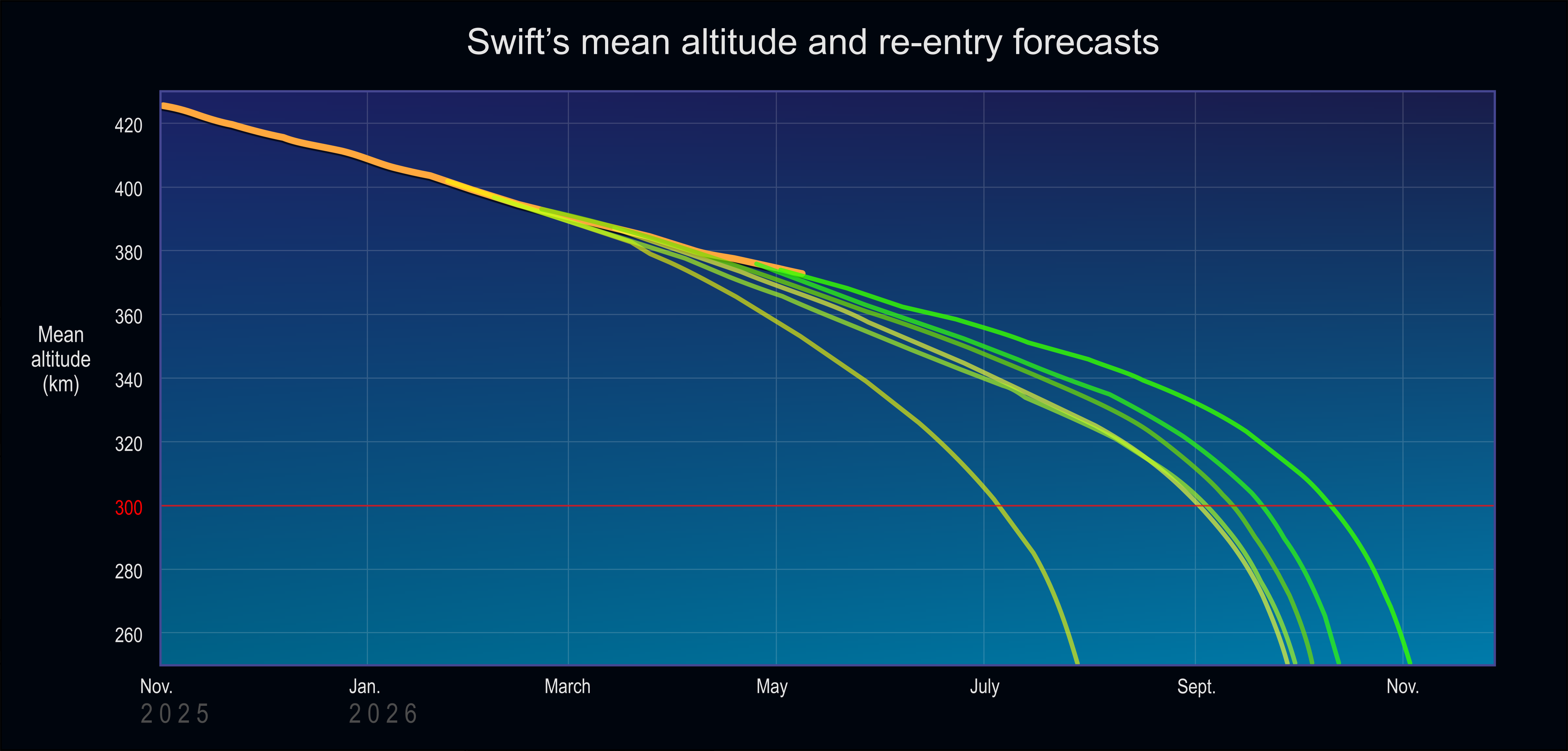
According to the latest forecasts from the Goddard Space Flight Center, Swift is expected to maintain an altitude above the critical 300 km mark at least until the early autumn of 2026. This extended timeframe will provide Katalyst Space’s LINK mission with more opportunity to rendezvous with Swift and attempt the orbital reboost.
Swift, launched in 2004 to observe gamma-ray bursts and high-energy cosmic events, is currently experiencing a slow but steady orbital decay. Like many satellites in low Earth orbit, Swift is subject to the drag of Earth’s atmosphere, which progressively reduces its altitude over time. This issue has been exacerbated in recent years by intense solar activity associated with the 2024 solar maximum.
Throughout 2025, various predictive models indicated a potential atmospheric reentry as early as the summer of 2026. Consequently, NASA awarded Katalyst Space a contract to develop an orbital servicing mission capable of elevating the telescope’s orbit, serving as a test. The LINK vehicle, currently in preparation for launch, must reach Swift and perform a reboost maneuver to extend its operational lifespan.
In the meantime, the Swift mission team has modified the satellite’s orientation in space to minimize atmospheric drag. These adjustments have already slowed orbital decay and improved the prospects for the LINK mission.
NASA’s New Predictions for Swift
Orbital predictions for Swift are continuously updated by specialists at NASA’s Goddard Center. The models incorporate orbital data from the U.S. Space Force, information on solar activity, and operational details provided by the mission team. The objective is to accurately predict how the satellite’s altitude will change in the coming months.
Michael Shoemaker, deputy for flight dynamics for NASA’s science missions, explained that predictions evolve over time due to numerous factors, including space weather and the satellite’s attitude. Each operational change implemented by the Swift team is simulated to determine the additional mission time it can provide.
The variations between different predictions made in recent months clearly illustrate the impact of solar activity on orbital decay. In early 2025, almost all models suggested Swift would rapidly descend to altitudes too low for a reboost. Subsequently, thanks to the new operational strategies adopted by the team, the decay has been significantly slowed.
The 300 km altitude is considered particularly important, as operations for rendezvous and reboost become considerably more challenging below this threshold. However, the latest simulations indicate that Swift should remain above this limit long enough for LINK to attempt its mission.
An Important Mission for Orbital Servicing
This mission represents one of the most intriguing endeavors in the field of low Earth orbit satellite servicing. The concept of intercepting an operational satellite to alter its orbit is still relatively uncommon, particularly for NASA’s scientific missions.
The LINK vehicle is scheduled for launch in June 2026 aboard a Northrop Grumman Pegasus rocket. Once in orbit, the servicing satellite will need to approach Swift, synchronize its trajectory, and execute the orbital boost maneuver.
Russell Carpenter, deputy project manager for NASA’s SSMO division, stated that the mission’s preparation has garnered significant attention within the flight dynamics community. Beyond supporting Swift’s continued operation, the project has the potential to become a crucial testbed for future maintenance and operational extension missions for both scientific and commercial satellites. This could potentially include the Hubble Space Telescope.