

Brief entries on Wikipedia and in specialized publications are often all that introduce Johan Otto von Spreckelsen. This Danish architect (1929-1987), educated in his home country and a devotee of abstraction and refined geometry, had designed only a few modest temples when, to everyone’s and his own surprise, he was chosen in 1983 to oversee the construction of the Grande Arche de la Défense in Paris. This ambitious project was not only conceived as a structure open to the world but also intended to complete the architectural perspective extending from the Tuileries Gardens to Napoleon’s Arc de Triomphe.
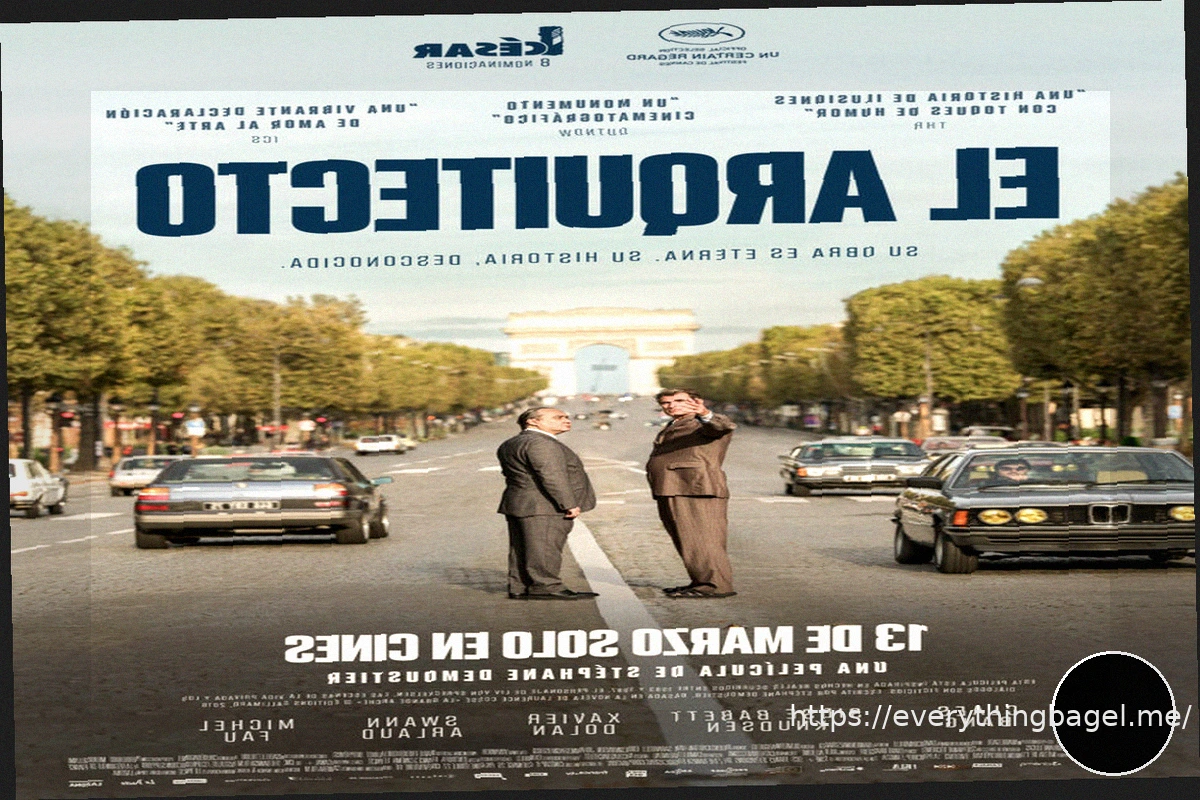
This was a colossal undertaking driven primarily by President Mitterrand’s ambition to leave his indelible mark on the city’s historic axis, coinciding with the bicentennial of the French Revolution. (Around the same period, the Louvre underwent extensive renovations, and the Opéra Bastille was created). It is precisely the president and his inner circle who open Stéphane Demoustier’s film The Architect, which arrives in cinemas this weekend and aptly bears the French title L’inconnu de la Grande Arche (The Unknown of the Grande Arche). The politician presents the project to his team as his own, proudly reviewing the winning design from the competition. Only after several minutes of discussion do they remember to deliver the theoretical good news to Spreckelsen, whom no one knew – and whom they subsequently struggle to locate.
What unfolds is a plot blending elements of both comedy and drama, where the Danish architect’s strenuous efforts to complete the building in adherence to his initial plans prove far more challenging than Hercules’ legendary labors. It is less Mitterrand himself and more his surrounding, ever-impenetrable bureaucracy that transforms the process into a relentless succession of major and minor obstacles. What legislation doesn’t prohibit, their lack of imagination quickly derails, often fueled by the petty pleasure of the mediocre in hindering the brilliance of others.
Scenes in The Architect draw clear parallels with the recent film The Brutalist and King Vidor’s classic The Fountain, inspired by Ayn Rand’s novel, which famously paved the way for cinematic portrayals of architects misunderstood by short-sighted clients. Examples include Spreckelsen’s (played by fellow Dane Claes Bang) visit to the Carrara marble quarries, his unsettling ascent by elevator to seemingly undeserved heights, or the presence of Sidse Babett Knudsen as his wife, attempting to guide his steps back towards pragmatism and ground his soaring thoughts.
Nevertheless, in Demoustier’s work, despite the architect’s meticulous and deeply ingrained respect for his clients and his struggle to prevent the initial design of the arch from being compromised, there is no epic narrative. The true history of Spreckelsen’s project would have made an epic portrayal difficult: facing constant tensions with the French staff assigned to assist him, he ultimately withdrew from the construction’s direction in 1986, and others completed it. He passed away the following year, and given his relative youth, it’s not unreasonable to consider that the immense stress and professional weariness associated with this monumental arch played a significant role.
Demoustier portrays him as a man of integrity and a professional navigating a swarm of bureaucrats who ultimately stifle artistic creation, yet the film intentionally avoids presenting him as an outright hero. Against the formidable political machinery, his numerous attempts to preserve the purity of his work and bring a grand vision to fruition are ultimately destined for failure: Mitterrand, the film implies, is no benevolent patron like Julius II, even if Michelangelo also sought fresh inspiration in Carrara.
The story is set in the eighties, and the audience instinctively knows that the artist with a soul will ultimately lose against the arbitrary dictates of bureaucratic offices. Consequently, his endeavors sometimes appear admirable, and at other times, dramatically ludicrous. And because he spends more time in meetings – negotiating or arguing – and entangled in power games than on the actual construction site, the audience understands, long before the conclusion, that this is a truthful and even rigorous account of monuments, public money, and creators who are ultimately unable to create.