

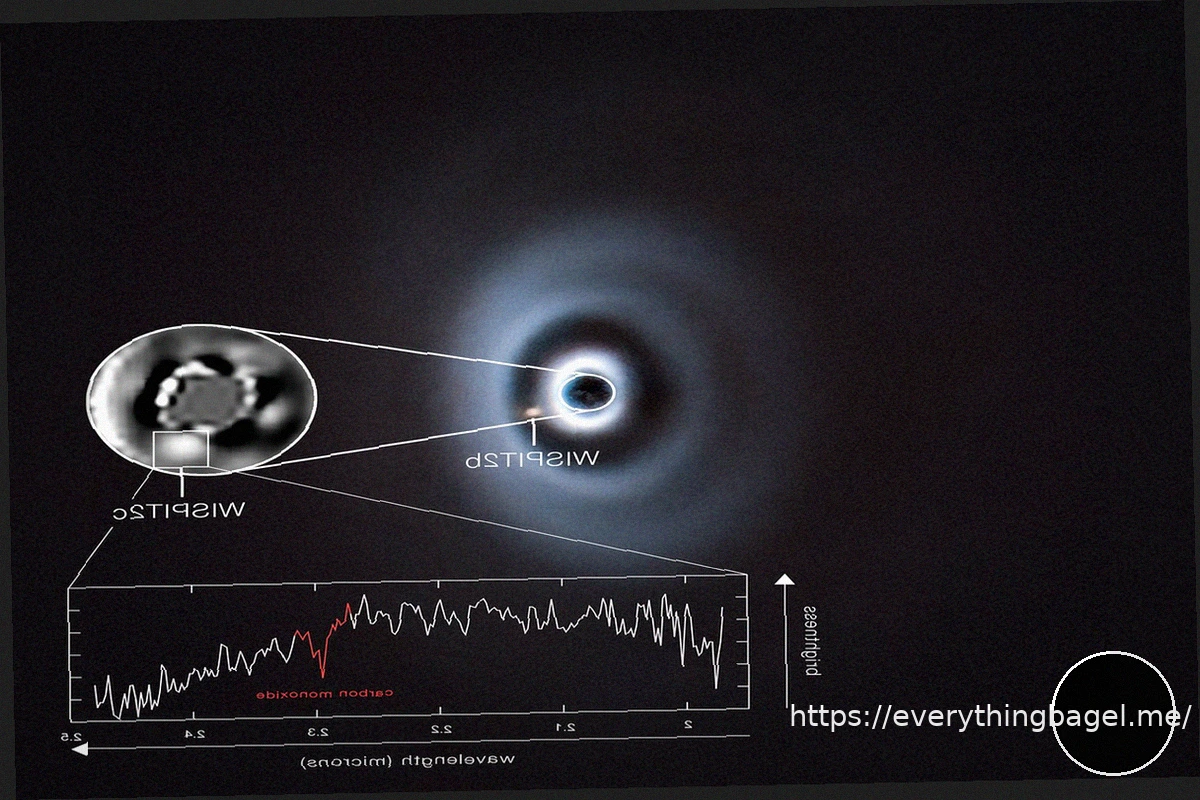
Understanding planetary formation is a cornerstone of modern astronomy. While it’s known that planets emerge from disks of gas and dust encircling young stars, directly witnessing this process remains an exceptional event. The WISPIT 2 system thus proves to be of extraordinary interest, as it has allowed astronomers to observe the simultaneous birth of two worlds.
This discovery, documented in The Astrophysical Journal Letters on March 24, 2026, ranks among the rare instances of directly studying the multiple planet formation within a single system. Previously, only the PDS 70 system had offered a comparable research opportunity.
The star WISPIT 2 is enveloped by a vast protoplanetary disk, characterized by distinct rings and regions devoid of material. These configurations are not random; they signal the presence of entities that are ‘clearing’ the disk along specific orbital paths, very often indicating the formation of planets.
Through observations conducted with telescopes of the European Southern Observatory (ESO), researchers have validated the existence of a second planet, named WISPIT 2c, which joins the already identified WISPIT 2b. This system thus becomes an ideal natural laboratory for investigating the mechanisms of planetary system formation and evolution.
Planetary Formation Mechanisms within the Disk
The first planet detected, WISPIT 2b, is a gas giant with a mass approximately five times that of Jupiter. Its orbit extends a remarkable distance from its host star, about 60 times the Earth-Sun distance. The second planet, WISPIT 2c, is even more massive, nearly double the mass of WISPIT 2b, but, unlike its companion, it orbits much closer to the star. WISPIT 2c is also a gas giant, comparable to Jupiter and Saturn in our Solar System.
Both planets are situated within regions of the disk devoid of material, known as gaps. These empty zones are intrinsically linked to the planetary formation process: as planets develop, they attract surrounding material, thereby creating a ‘clear’ orbit. The residual material, in contrast, aggregates into distinct rings, which are clearly observable.
The achievement of these results was made possible through the use of cutting-edge instrumentation. The SPHERE spectrograph, integrated into the Very Large Telescope (VLT), provided direct images of the system. Subsequently, the GRAVITY+ instrument, operating on the VLT Interferometer (VLTI), definitively validated the planetary nature of the second observed object.
Within the disk, a third gap is also observed, smaller and less defined, whose presence might suggest the existence of a third planet not yet directly detected.
A System Mirroring Our Cosmic Past
The WISPIT 2 system is of particular relevance, as it offers a rare opportunity to observe the co-formation of multiple planets within the same system. This allows astronomers to delve deeper not only into the genesis of a single celestial body but also into the entire architecture of a planetary system.
The detected planets are gas giants, analogous to Jupiter and Saturn. Furthermore, the disk’s configuration, characterized by rings and gaps, aligns perfectly with theoretical models outlining the primordial phases of our Solar System.
The potential existence of a third planet, whose mass might be comparable to that of Saturn, would further increase the interest in this system. Its eventual detection could corroborate the hypothesis that planetary systems develop through a complex series of interactions between nascent planets and the surrounding disk, progressively shaping the final architecture.
Future observational campaigns will be of crucial importance. In particular, the Extremely Large Telescope (ELT), currently under construction and with first light expected in 2029, could enable the direct observation of this hypothetical third planet and allow for an even more in-depth study of the entire system.