


Tracey Emin’s career is marked by an unwavering commitment to unapologetic self-expression. Since her beginnings in the 1980s, she has consistently linked her art to exploring passion, pain, and healing, using the female body and its surrounding world as her primary medium.
The most extensive exhibition of her work to date, “A Second Life,” is currently on view at Tate Modern in London until next summer. It spans nearly four decades of her artistic journey, featuring early installations like the seminal My Bed, alongside recent and previously unseen paintings and bronze sculptures.
Reflecting how her art is intrinsically tied to her biography and emotions, this anthology is titled “A Second Life” and was organized in close collaboration with Emin herself. It comprises around a hundred works—including paintings, videos, textiles, neons, sculptures, and artifacts—through which she shares, with raw and unflinching honesty, experiences of love, trauma, and personal growth.
The exhibition begins with pieces from Emin’s first solo show, a collection of works from the 1980s and early 1990s presented at the White Cube. Visitors can see photographs of paintings she created during her formative years—the originals were destroyed during a difficult period—alongside Tracey Emin CV (1995), a narrative self-portrait of her life up to that point, and the poignant video Why I never became a dancer (1995), Emin’s own account of traumatic adolescent experiences in Margate. Presented together, these works immediately immerse the viewer in the intimate, unfiltered nature of her art.
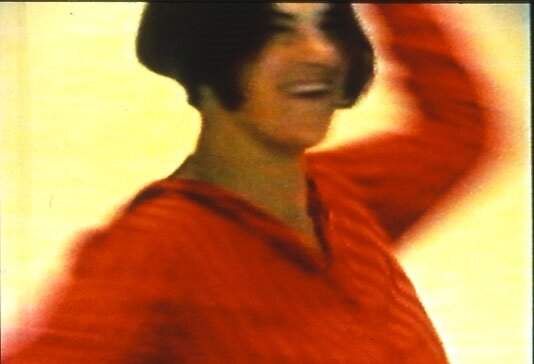
Tracey Emin. Why I never became a dancer, 1995. Tate. © Tracey Emin
Emin’s deep connection to Margate, her birthplace, has resonated throughout her past and present projects. After leaving abruptly at just fifteen, she returned intermittently during her adolescence and youth before moving to London in 1987 to study at the Royal College of Art.
After her mother’s death in Margate in 2016 and her own battle with bladder cancer in 2020, Emin decided to settle there permanently. In this coastal town, popular with tourists and English language students, she established not only her home but also the Tracey Emin Artist Residency, a free art school with its own studio. Many works at the Tate are connected to this place and her continually revisited and explored childhood memories. Notable pieces include Mad Tracey from Margate: Everybody’s been there (1997), which highlights her turbulent years there, revealing her thoughts through embroidered phrases, letters, and drawings; and It’s not the way I want to die (2005), a wooden rollercoaster inspired by the Dreamland amusement park, through which she aimed to dissect her anxieties and fragility.
For Emin, exposing her pain has been a way to reduce or eliminate the stigma surrounding it, acknowledging that such issues are often left unaddressed. The 2007 neon I could have loved my innocence and the 2009 embroidered piece Is this a joke refer to sexual assault. The video How it feels (1996) focuses on her defiant account of a botched abortion, detailing institutional negligence and the physical and psychological implications of rejecting motherhood in her case. She revisited this theme in the quilt The last of the gold (2002), exhibited for the first time, which incorporates advice for women facing similar situations.
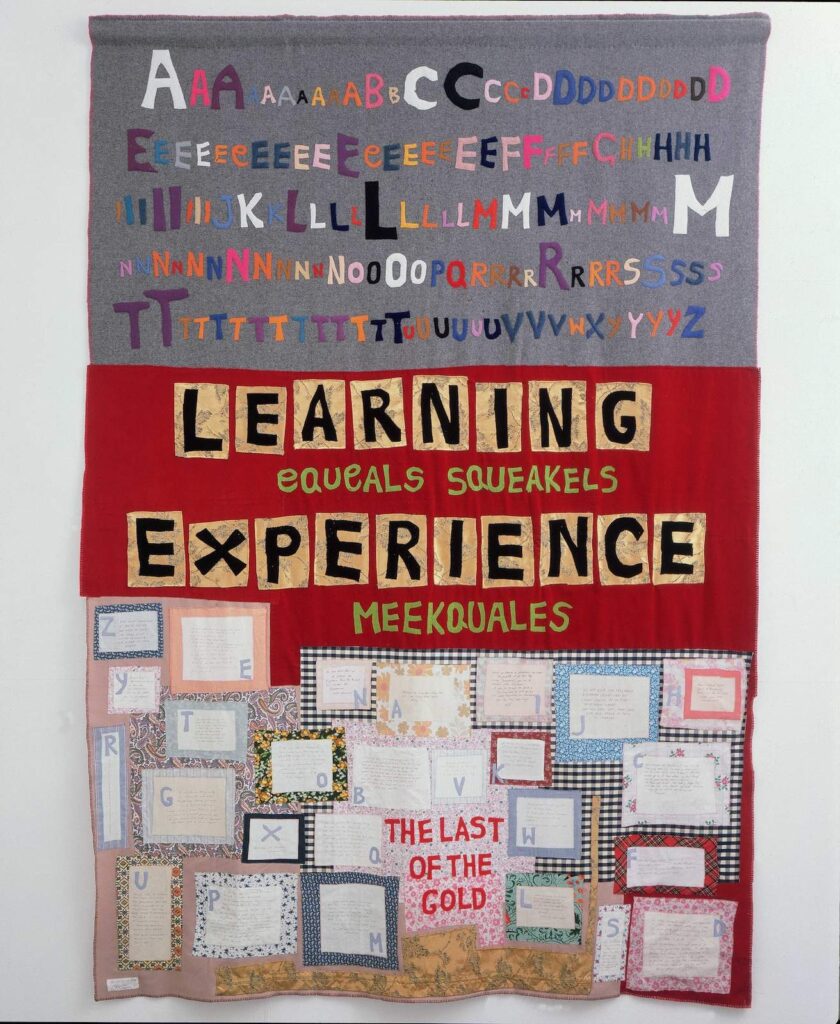
Tracey Emin. The last of the gold, 2002. The Levett Collection. © Tracey Emin
Two installations take center stage in the exhibition: Exorcism of the last painting I ever made (1996), which documents the three weeks Emin spent locked in a Stockholm gallery, attempting to reconcile with painting after abandoning it six years prior following her abortion experience; and the aforementioned My Bed, nominated for the Turner Prize in 1999, which symbolized her recovery from an alcohol-induced crisis. These works invite visitors to transition from what could be considered Emin’s “first life”—before this bed, before that cancer and surgery—to her “second life.”

Tracey Emin. My bed, 1998. Courtesy of The Saatchi Gallery, London
Her experience with illness is openly explored in this exhibition, emphasizing her rejection of any division between the personal and the public. The recent bronze sculpture Ascension (2024), which delves into Emin’s new relationship with her body after tumor removal, is complemented by new photographs showing the stoma with which she now lives.
The retrospective culminates with the artist exploring the dimensions of this second chance through painting. While pain and anguish are still present, her ambitious large-format paintings offer a transcendent and spiritual quality, demonstrating a firm determination to live in the present. Alongside these, Death Mask (2002) illustrates a life lived to its fullest.
Beyond the Tate’s walls, another monumental bronze sculpture, I followed you to the end (2023), dominates the museum’s exterior area, foreshadowing the visceral intensity within.
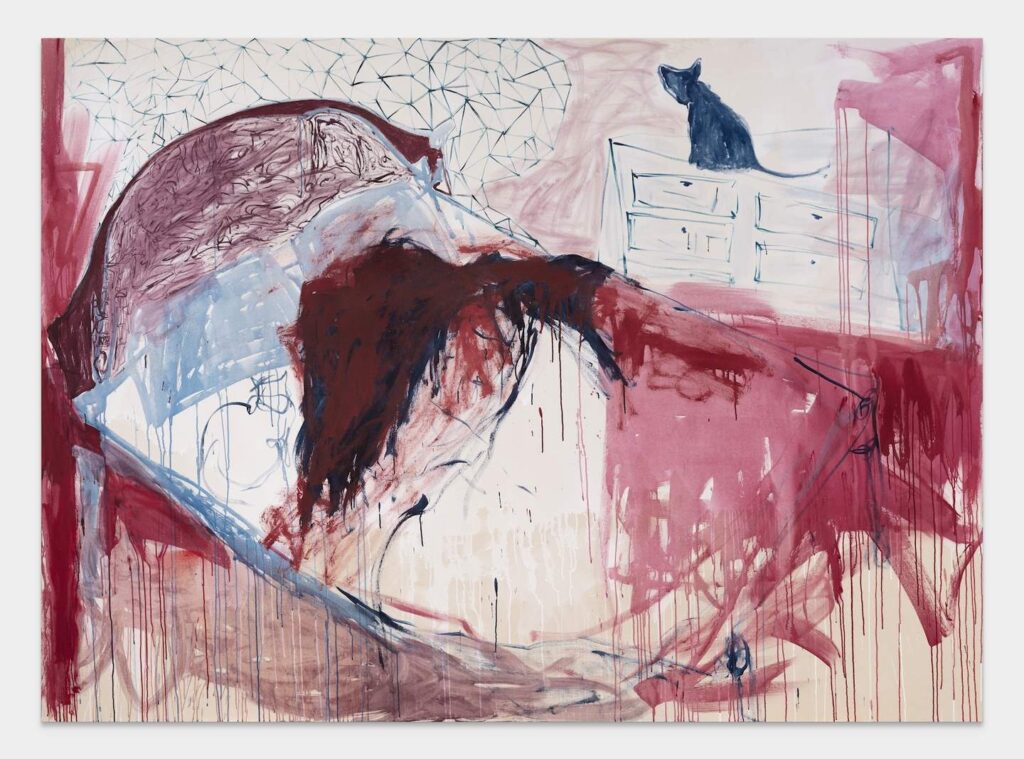
Tracey Emin. The end of love, 2024. Tate © Tracey Emin
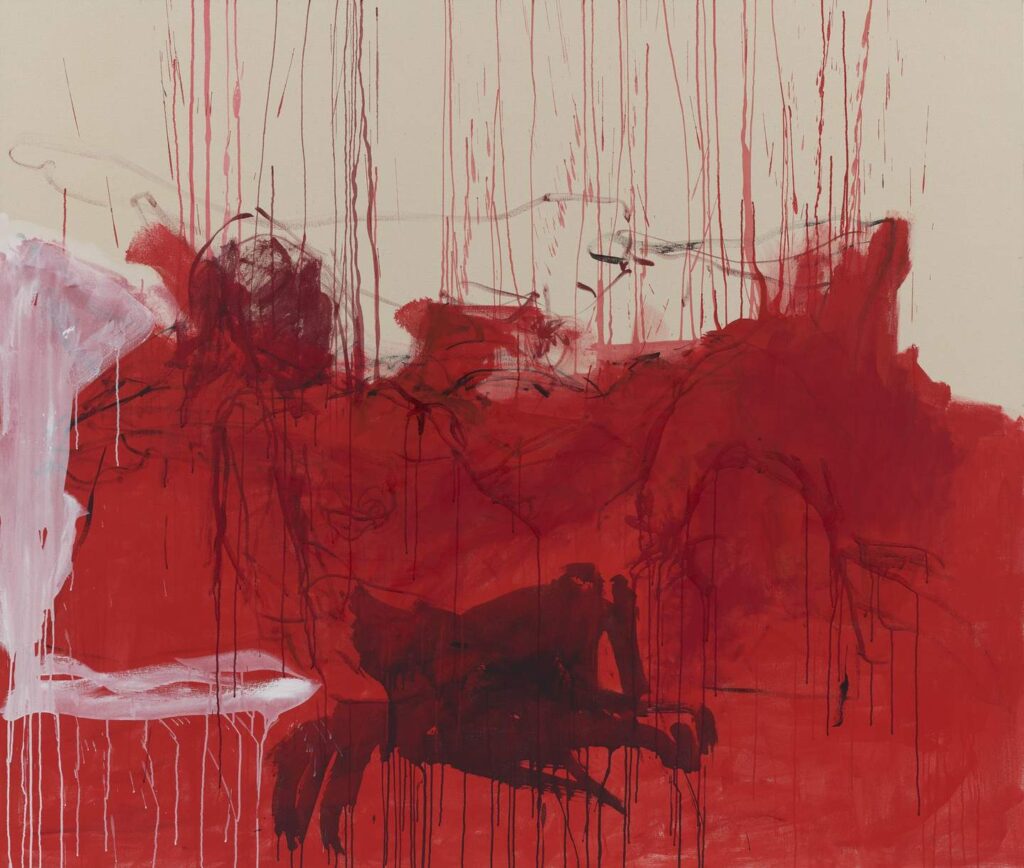
Tracey Emin. I never asked to fall in love – You made me feel like this, 2018 © Tracey Emin