

Two years ago, Yuko Mohri represented Japan at the Venice Biennale with an installation where the focus wasn’t on individual artworks, but on light, sound, scent, and movement that permeated her country’s pavilion, altering visitors’ perception of its architecture.
Only two pieces were needed to create this *event*: *Moré Moré (Leaky)* and *Decomposition*. Both are now featured in ‘Interweavings,’ Yuko Mohri’s exhibition at the Centro Botín in Santander, marking her first in Spain and her most comprehensive to date in Europe.
Born in 1980 in Kanagawa and based in Tokyo, Mohri crafts installations using natural elements and everyday objects. These works engage viewers, transforming their sensory experience of the exhibition space, encompassing not only visual but all other senses. From these components, she constructs interconnected, ephemeral systems that transcend physical perception, addressing contemporary social and environmental issues. Her art particularly encourages reflection on the interdependence within ecosystems and the potential for repairing damage and repurposing what is considered ‘withered’ or worn.
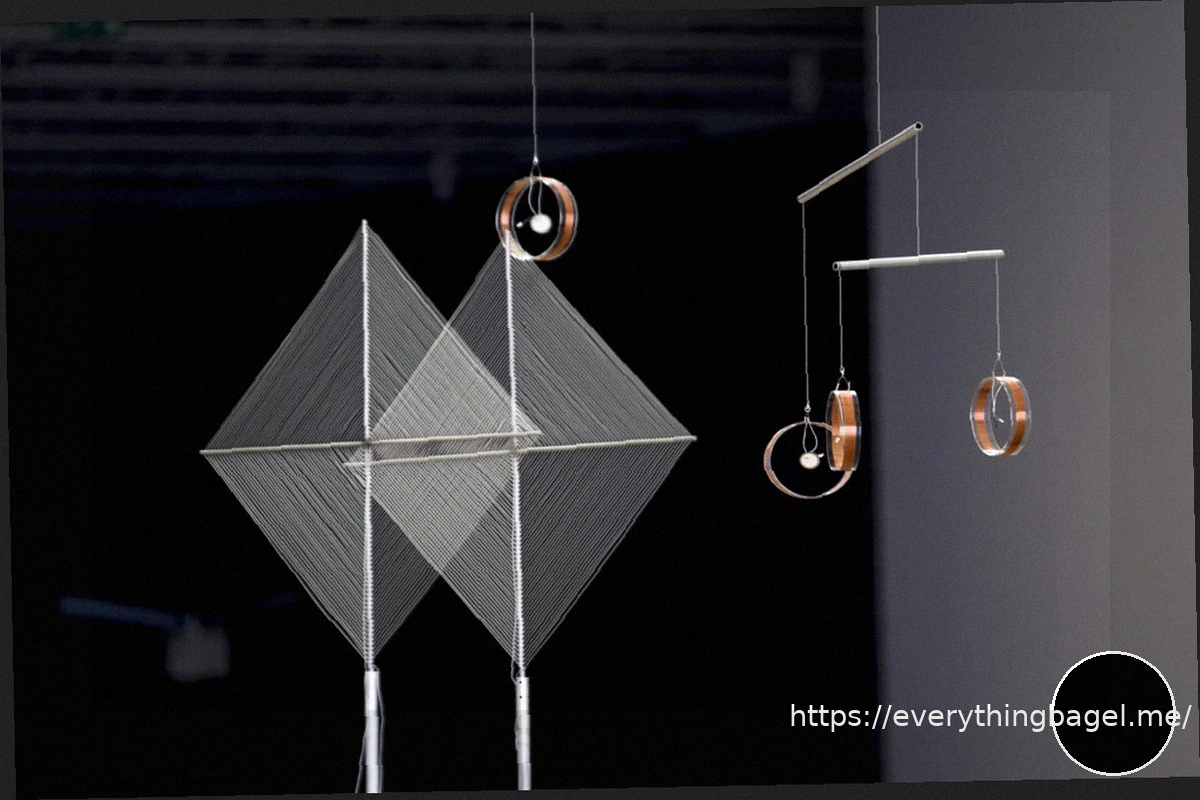
Mohri draws inspiration from Duchamp and Calder for her kinetic sculptures. Each piece is site-specific, utilizing found objects and re-engineered musical instruments connected to electronic circuits. These installations react to subtle, transient environmental conditions such as gravity, heat, humidity, and magnetism. Her assemblages transform into miniature organic ecosystems, whose configurations would change with variations in air, dust, debris, or temperature.
The works gathered in Santander, some of which were recently displayed at the Pirelli HangarBicocca in Milan, span from 2000 onwards. This allows visitors to observe how Mohri continually adapts and reworks her pieces over time for each new venue. As she describes it, she twists and weaves them, embracing three concepts that others often avoid: error, improvisation, and feedback.
The exhibition ‘Interweavings’ highlights the complex and often elusive interactions between objects, sounds, people, and the natural and artificial worlds. These relationships are dynamic and evolving, further shaped by the artist’s philosophical influences and the iconography of pop art.
Each of Mohri’s creations originates from a central driving force, establishing a dynamic circuit. This is particularly evident in *Flutter* (2018), centered around an aquarium with sensors that capture light and shadows naturally produced by the movement of fish and aquatic plants. These movements, in turn, trigger other interdependent actions, creating a piece closely connected to the sound experiments of John Cage and the video art of Nam June Paik.
Also presented in Santander is *Piano Solo: Belle-Île*, which features a modified piano programmed to play autonomously. Mohri conceived this piece during the pandemic when her usual collaborations with musicians were impossible. She retreated to a forest, recording ambient sounds—birds, a stream, the wind—and then programmed the piano to translate these sounds into a musical composition.
The title *Belle-Île* references the location where Monet painted his first series, and where Mohri filmed a video on a cliff edge. For the Santander exhibition, she recorded ambient sounds from various coastal areas around Santander, evoking Satie’s concept of ‘furniture music,’ where sounds integrate into the environment without demanding active listening. Satie famously challenged the conventions of concert music.
Visitors can also experience *You Locked Me Up in a Grave, You Owe Me at Least the Peace of a Grave* (2018), an immersive work that combines sound, light, and movement to create a choreography. A suspended, rotating spiral staircase, both sculptural and dynamic, evokes a planet revolving on its axis. It is surrounded by four loudspeakers that distort and amplify sound, causing it to reverberate throughout the Centro Botín.
The title of this project comes from the words spoken by French revolutionary Louis-Auguste Blanqui during a prison interview with art critic Gustave Geffroy. At the time, Blanqui was writing *Eternity by the Stars* (1872), a philosophical work that captivated Walter Benjamin and explored the concept of circularity—an idea, as evident, deeply embedded in Mohri’s artistic processes.
Also featured in this exhibition are *Decomposition* and *Moré Moré (Leaky)*, two ongoing series previously shown at the Venice Biennale. *Decomposition* explores organic decay, transforming it into a living system of sound and light. It connects decaying fruit to electronic devices via electrodes; as the fruit rots and loses water, it generates electricity that activates sound compositions and controls light.
These compositions are ever-changing, varying with the level of decay and hydration, producing audible and visible signals of the work’s mutable essence. Amplifiers, speakers, and vintage furniture complete the installation, evoking the atmosphere of Renaissance still lifes.
Regarding *Moré Moré (Leaky): Variations*, the series began as photographs documenting temporary solutions used by Tokyo Metro workers to address water leaks in a station. These observations evolved into kinetic artworks crafted from everyday household items like umbrellas, pots, and pans, re-imagined with Mohri’s characteristic DIY sensibility.
The exhibition concludes with *I/O*, one of Mohri’s earlier works, whose title refers to ‘input’ and ‘output.’ This piece creates an organic ecosystem where movement and form are shaped by the specific characteristics of the Centro Botín’s exhibition space, embracing its inherent randomness. Paper rolls suspended from the ceiling lightly brush the floor, collecting dust. This dust is then read by a scanner, which translates it into electrical signals that activate light bulbs, tools, and instruments.
Mohri transforms our waste into melody, in a highly creative exercise of circular economy.