


NASA’s Dragonfly mission, an eight-rotor drone designed for exploring Titan, has entered a new development phase, with the assembly of the vehicle’s main structure and initial testing of various systems underway.
In recent weeks, the panels forming the lander’s body have been delivered. These were designed by the Johns Hopkins Applied Physics Laboratory and built by Lockheed Martin Space using an aluminum honeycomb structure. The metal sheets are only 0.01 inches thick (just over a quarter of a millimeter), significantly thinner than typical for space missions. This choice minimizes mass, a crucial requirement for a vehicle intended to fly in Titan’s atmosphere. The entire structure weighs approximately 230 pounds (just over 100 kg) but is designed to withstand the stresses of launch and atmospheric entry.
In early April, fuselage assembly began, integrating several fundamental components. These include the plate and cover for the radioisotope thermoelectric generator, which will power the mission and will be installed shortly before launch. A preliminary compatibility check of the upper platform, intended to house part of the telecommunications system, was also conducted. In the coming months, the vehicle will undergo structural tests to verify its resistance to the stresses expected during launch and descent.
Parachute Testing and Structural Verifications
With the structure in the integration phase, the team is preparing for tests that will simulate the conditions of launch and arrival on Titan. Vibration and static load tests are scheduled for May to measure the lander’s response to mechanical stresses.
Another central element is the descent system. In February, a series of tests were completed with a full-scale parachute system, including both the drogue and main parachutes. The tests were conducted in the United States with support from NASA centers and Airborne Systems, aiming to replicate conditions similar to Titan’s atmosphere.

The parachute will be responsible for the initial deceleration phase during atmospheric entry, a critical step to allow the lander to reach the surface safely. A new testing campaign is planned for October 2026, before the flight systems are manufactured.
DraMS Laboratory Nears Completion
Meanwhile, work continues on the scientific payload. At NASA’s Goddard Space Flight Center, the integration of the Dragonfly Mass Spectrometer (DraMS) is in its advanced stages. This instrument will analyze samples collected on Titan’s surface.
DraMS uses two techniques to extract and study molecules: laser desorption and gas chromatography. In the former, a laser pulse releases compounds from a solid sample; in the latter, material is heated, and molecules are separated before analysis. In both cases, substances are identified using mass spectrometry.
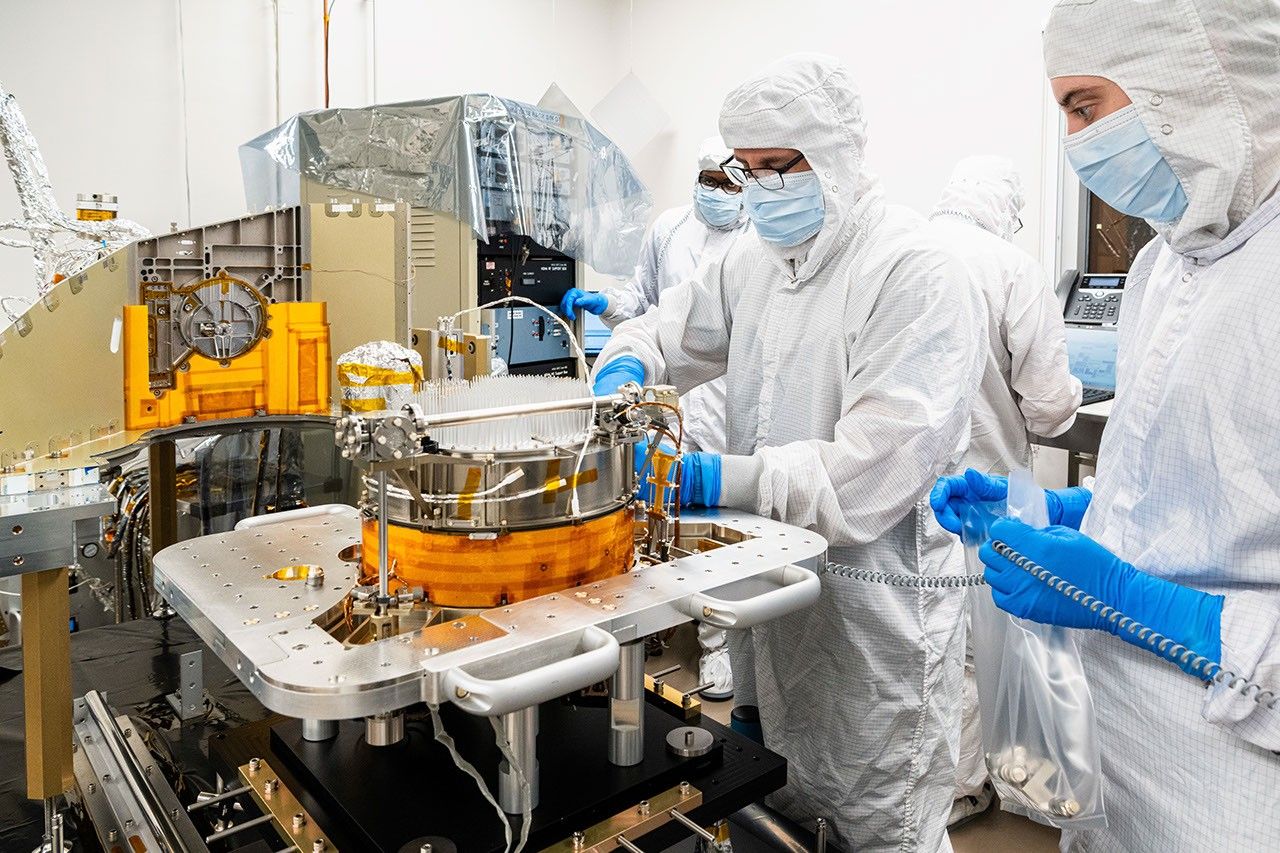
On April 15, the test of the instrument’s integrated laser system was completed. Using samples with known compositions, engineers verified its ability to identify substances even in very small quantities. In the coming weeks, the gas chromatography system, provided by the French space agency CNES, will also be integrated and undergo similar testing.
The launch of Dragonfly is scheduled for July 2028, aboard a Falcon Heavy. After a journey of about six years, the mission will operate on Titan for approximately three years, moving between different sites to study its chemical composition and surface characteristics.