

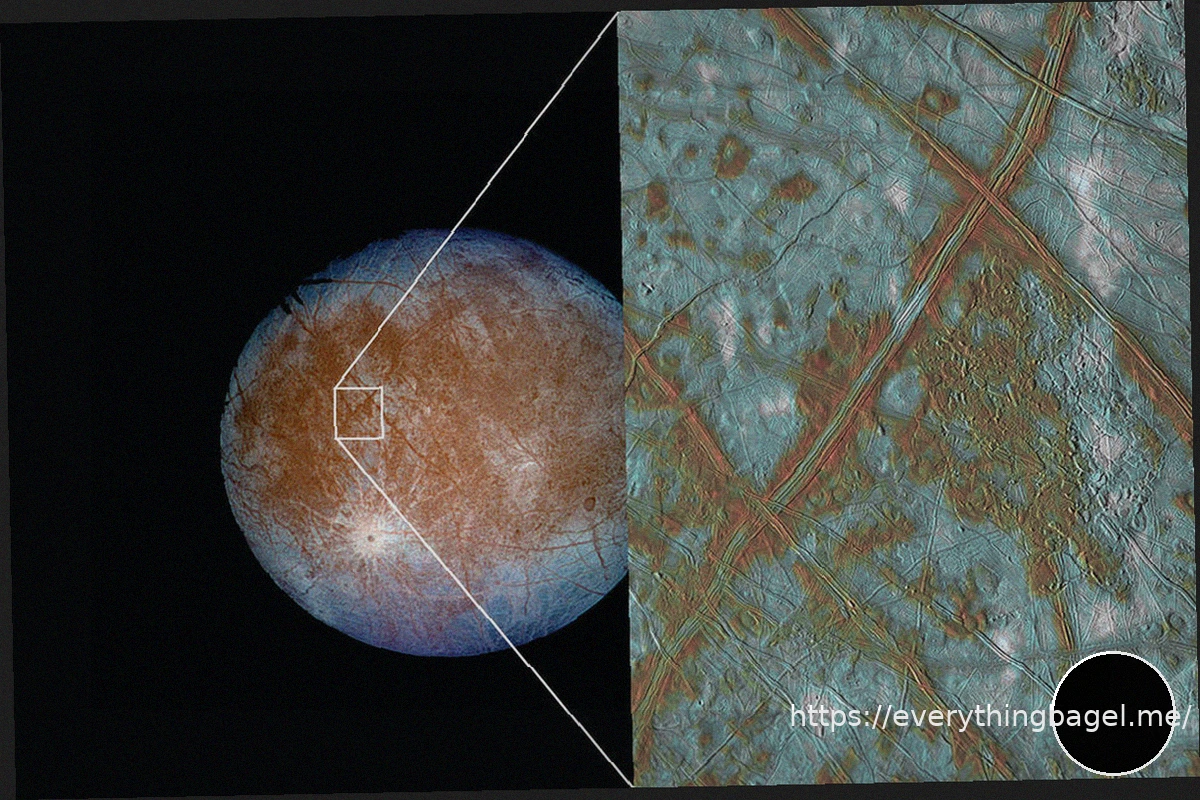
For over a decade, the presumed geysers of Europa, Jupiter’s icy moon, have been considered one of the most promising indicators of the satellite’s internal activity. Their potential discovery, announced in 2013 thanks to observations from the Hubble Space Telescope, had fueled scientific interest in this ice-covered moon, beneath whose surface a vast ocean of saltwater might exist. This hypothesis was particularly significant as it offered the possibility of studying material from the internal ocean without having to penetrate the icy crust.
However, a new study led by the same author responsible for the original discovery, now at the KTH Royal Institute of Technology in Stockholm, calls those conclusions into question. By re-examining data collected by Hubble between 1999 and 2020, researchers have found that the signals interpreted in 2013 as localized water vapor emissions were likely the result of image alignment errors and incomplete modeling of Europa’s extremely tenuous atmosphere.
The study, published in *Astronomy & Astrophysics*, represents a rare instance where the original discoverers themselves have critically re-evaluated their conclusions in light of new analyses and more accurate instruments. According to the team, the statistical evidence supporting the plumes would not be sufficient today to confirm their existence.
This does not mean Europa is geologically inactive, but rather that it has not yet been convincingly demonstrated that active geysers are present on its surface.
The Problem of False Signals in Ultraviolet Observations
The original discovery of the plumes was based on ultraviolet observations made with Hubble’s Space Telescope Imaging Spectrograph instrument. In 2013, a team led by Lorenz Roth identified an emission of hydrogen and oxygen above Europa’s south pole, interpreted as the result of water vapor plumes ejected into space, reaching heights of up to 200 km.
In the new study, scientists re-examined 23 sets of images collected over more than twenty years of observations, focusing particularly on hydrogen’s Lyman-alpha emissions. The analysis confirmed the existence of a global hydrogen exosphere around the moon, with a density even higher than previous estimates. However, no localized emissions consistent with geysers were found.
According to the researchers, the crucial issue lies in the positioning of Europa’s disk on Hubble’s detector. A deviation of just one or two pixels would have been sufficient to artificially create brighter regions, transforming them into apparent emission signals. Tests conducted by the researchers with synthetic data show that these small errors can produce false positives with a statistical significance greater than 4 sigma.
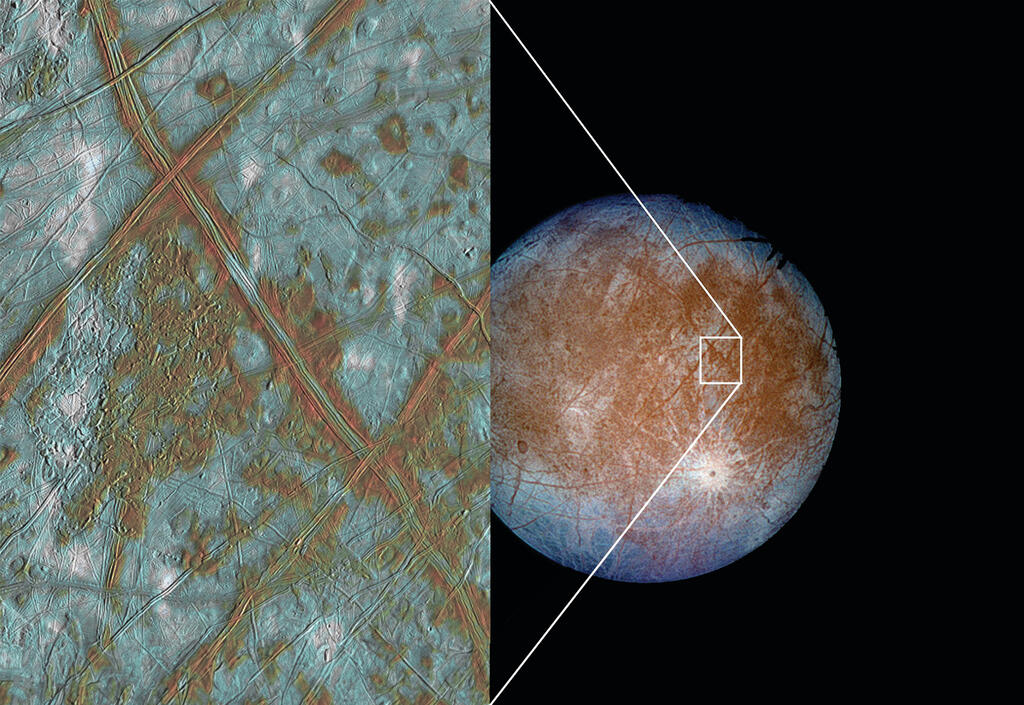
Detail of Europa’s surface. Credits: NASA
The inclusion of the global hydrogen exosphere in the new model also played a decisive role. The diffuse signal produced by this tenuous atmosphere had initially been interpreted as an excess of local emission, while the new analysis demonstrates that it is a global phenomenon distributed around the moon.
Europa Remains a Key Target for Planetary Exploration
Despite the revised evidence regarding geysers, Europa continues to be one of the most intriguing bodies in the Solar System for the study of extraterrestrial habitability. Observations collected over the past few decades indicate the presence of a global ocean hidden beneath tens of kilometers of ice, likely kept liquid by tidal heating generated by gravitational interaction with Jupiter.
The possible existence of plumes remains one of the most fascinating hypotheses. On Enceladus, for example, water and ice geysers have been directly observed by the Cassini probe, providing valuable information about the composition of the moon’s subsurface ocean. If similar phenomena were present on Europa, future space missions could sample material ejected into space without landing or drilling into the ice.
According to Giuseppe Piccioni, a researcher at INAF (National Institute for Astrophysics) in Rome involved in ESA’s JUICE mission, the data collected so far has always remained ambiguous and has never provided definitive confirmations. The new analyses, he explains, do not completely rule out the existence of plumes but show how complex it is to distinguish real signals from instrumental effects in ultraviolet observations.
ESA’s JUICE mission and NASA’s Europa Clipper, arriving in the Jovian system in 2031 and 2030 respectively, will be tasked with definitively clarifying the issue in the coming years, thanks to instruments specifically designed to study the surface, atmosphere, and interior of the icy moon.