

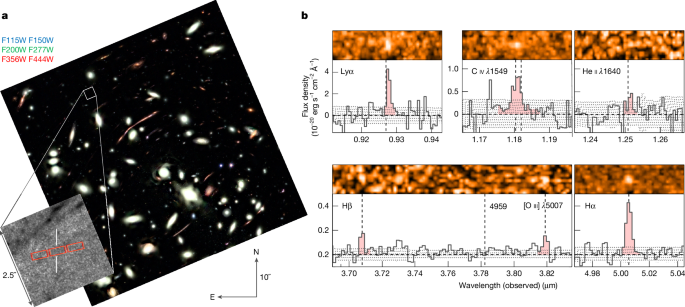
More than 13 billion light-years away, the James Webb Space Telescope has observed one of the most primitive galaxies ever studied. Named LAP1-B, it is an extremely faint object. Its chemical composition is particularly noteworthy: it contains only 1/240 the amount of oxygen present in the Sun, one of the lowest values ever measured in such a distant galaxy.
This discovery comes from an international team led by Kanazawa University in Japan, with participation from Eros Vanzella of the National Institute for Astrophysics (INAF) in Bologna. Thanks to over 30 hours of James Webb observations, researchers have identified LAP1-B as a veritable cosmic “time capsule,” capable of revealing what the first galaxies looked like during the era of reionization, the period when the first stars began to illuminate the Universe.
Observing such an object would normally be impossible because LAP1-B is too small and dim. Its light has been amplified more than a hundredfold by a gravitational lens: an effect produced by the mass of galaxies and dark matter situated along the line of sight, which distorts and magnifies the light coming from the distant galaxy.
According to researchers, LAP1-B may represent some of the best observational evidence of the chemical conditions left by the very first stars in the Universe. The high carbon-to-oxygen ratio detected in the galaxy is indeed consistent with simulations describing the material expelled by the explosions of first-generation stars, born when the cosmos was still almost entirely composed of hydrogen and helium.
A Galaxy Almost Devoid of Heavy Elements
Shortly after the Big Bang, the Universe contained almost exclusively hydrogen and helium. All heavier elements, such as oxygen, carbon, and iron, formed later within stars through nuclear fusion processes. When these stars ended their lives by exploding as supernovae, they dispersed the newly formed chemical elements into space, gradually enriching the cosmos.
For this reason, the chemical composition of the oldest galaxies is crucial information for understanding the evolution of the early Universe. The poorer a galaxy is in heavy elements, the more likely it is to be observed in a phase very close to its initial formation.
In the case of LAP1-B, the data collected by James Webb show an extreme scarcity of oxygen, never before observed with this level of detail in such a distant object. According to Kimihiko Nakajima, the study’s lead, this chemical signature indicates that the galaxy is still in a very primitive state, likely shortly after the onset of star formation.
The carbon-to-oxygen ratio has also captured the researchers’ attention. The distribution of these elements precisely matches the theoretical predictions for the explosions of Population III stars, the first stars born in the Universe. These stars have never been directly observed, but astronomers have been searching for their indirect traces in the oldest galaxies for years.
A Window into the Universe’s First Galaxies
In addition to its chemical composition, LAP1-B has also impressed astronomers with its extremely low mass. The galaxy contains less than 3300 solar masses, a very low value compared to galaxies normally observed in the early Universe. This suggests that a significant portion of its mass is composed of dark matter.
According to the team, LAP1-B could therefore represent an example very similar to the progenitors of the ultra-faint dwarf galaxies observed today around the Milky Way. These are small galactic systems with very few stars, long considered possible “fossils” of the early Universe. Vanzella commented:
We are observing a tiny region of the Universe, spanning a few tens of light-years, where one of the very first episodes of star formation might be occurring in an environment almost devoid of chemical elements.
The discovery, the researcher explains, was only possible due to the combination of James Webb’s sensitivity and the gravitational lensing effect, which enormously amplified the galaxy’s light.
In recent months, the telescope has begun identifying other similar objects, also thanks to gravitational lenses. For astronomers, these observations represent a new opportunity to directly study the early stages of galactic formation and understand how the Universe transitioned from the first stars to the cosmic structures observable today.
The abstract of the study, published in Nature, can be found here.