

Starship has returned to flight. The twelfth test launch proceeded successfully and was one of the most interesting of the entire program. Not everything in the new V3 version of Starship worked as planned, but overall, problems were few and primarily concentrated on the Raptor 3 engines.
The launch occurred at 00:30 Italian time, with a slight delay due to a hold of a few seconds at T-40 seconds. The exact reasons for this temporary stop are not yet precisely known, but the issues that led to the cancellation of the first attempt seem to have been resolved. In that case, the main problem appeared to be a connector for the Quick Disconnect system, the arm that refuels Starship and must detach a few seconds before liftoff.
At liftoff, all 33 Raptor engines of the Super Heavy ignited correctly. The flame diverter of Pad 2 was also seen in action, used for the first time during a real launch. The V3 lifted off the ramp faster than the previous V2: after one minute of flight, it was already at an altitude of 8.2 km, compared to the 6.8 km of the eleventh Starship flight, and was also about 200 km/h faster.
Raptor Engine Issues
However, after approximately one minute and 40 seconds, one of the Raptor engines on the outer ring of the Super Heavy shut down. The flight continued until the hot staging, which occurred nominally. After separation, the booster began the boostback burn maneuver, which did not go as planned. From live footage, it appears that one of the engines was heavily damaged, causing several nearby engines to shut down. This caused the Super Heavy to rotate significantly, although it managed to regain its attitude for a period, also thanks to the work of the grid fins.
Six minutes and 20 seconds after launch, the booster crashed into the Gulf of Mexico. Telemetry still indicated a speed of about 1400 km/h at the time of signal interruption. The FAA has stated that it is not yet clear whether an investigation will be necessary for this off-nominal reentry.
The Ship, on the other hand, experienced an issue with one of its vacuum-optimized Raptor engines, which shut down about 36 seconds after ignition. Starship continued its flight with five engines, compensating for the loss and still reaching the planned trajectory. This particular problem led SpaceX to cancel the test of reigniting a Raptor in space.
A Starship Seen From Space
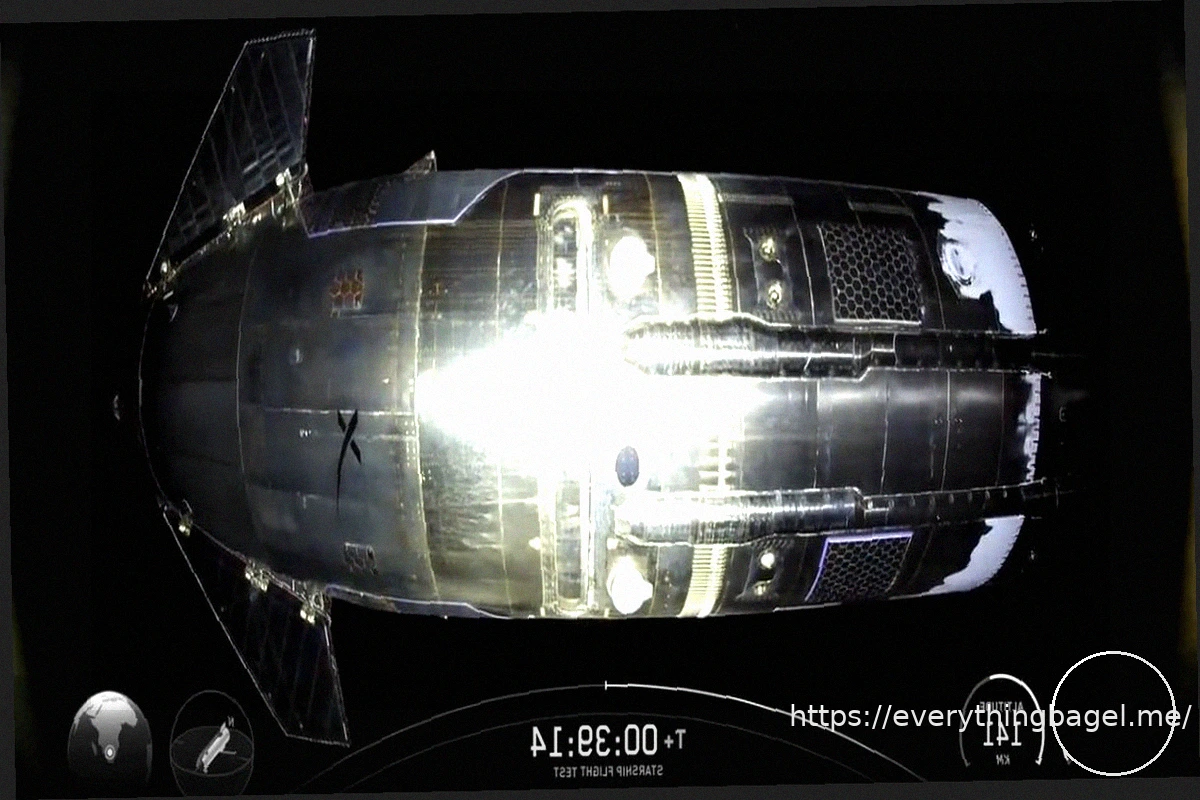
During the cruise phase, the payload bay door was opened, from which 20 mass simulators of Starlink V3 were released. Along with them were two actual Starlink satellites, which captured Starship from outside in space, providing some of the most significant images seen in the program so far.
The Ship’s atmospheric reentry was very clean. The trajectory was designed to particularly stress the lower flaps and simulate a possible approach towards Starbase. Around 50 km altitude, Starship maintained a very controlled descent, then accelerated more rapidly in the final phase. The ignition of two of the three central Raptors brought the Ship almost to a vertical position before its contact with the ocean.
After splashdown, Starship tilted onto its side and exploded. A debris recovery vessel was already present in the area.
With this explosion, Starship’s twelfth flight concluded: a test that was not perfect but overall very positive. Significant improvements remain to be made, especially on the Raptor engines, and it is likely that flight 13 will also maintain a suborbital trajectory. However, the timeline for the next launch could be shorter, perhaps as early as late June or July.
English Translation and Paraphrasing:
Original Text Snippets:
- “Starship è tornata in volo. Il dodicesimo lancio di test si è svolto correttamente ed è stato uno dei più interessanti dell’intero programma.”
- “Non tutto, della nuova versione V3 di Starship, ha funzionato come previsto, ma nel complesso i problemi sono stati pochi e concentrati soprattutto sui motori Raptor 3.”
- “Dopo circa un minuto e 40 secondi, però, uno dei motori Raptor dell’anello esterno del Super Heavy si è spento. Il volo è comunque proseguito fino all’hot staging, avvenuto nominalmente.”
- “La Ship, invece, ha avuto un problema a uno dei motori Raptor ottimizzati per il vuoto, spentosi dopo circa 36 secondi dall’accensione.”
- “Durante la fase di crociera è stato aperto il portellone di carico, dal quale sono stati rilasciati 20 simulatori di massa degli Starlink V3. Insieme a loro erano presenti anche due satelliti Starlink veri, che hanno ripreso Starship dall’esterno nello spazio, regalando alcune delle immagini più importanti viste finora nel programma.”
- “Dopo l’ammaraggio, Starship si è inclinata su un fianco ed è esplosa.”
- “Con questa esplosione si è concluso il dodicesimo volo di Starship: un test non perfetto, ma complessivamente molto positivo.”
Paraphrased and Translated English Text:
Starship has successfully returned to flight with its twelfth test launch, marking one of the program’s most compelling missions to date. While the new V3 Starship iteration encountered some unexpected issues, particularly with its Raptor 3 engines, the overall performance was strong with minimal problems.
The launch, which occurred at 00:30 Italian time, experienced a brief hold at T-40 seconds, reportedly due to a resolvable issue with the Quick Disconnect system, unlike the previous abort.
Initially, all 33 Raptor engines of the Super Heavy booster ignited flawlessly, and the Pad 2 flame diverter was utilized for the first time. The V3 ascended with greater speed than its predecessor, reaching 8.2 km in its first minute of flight, exceeding the eleventh flight’s altitude and velocity.
Challenges with Raptor Engines
Around 1 minute and 40 seconds into the flight, an outer ring Raptor engine on the Super Heavy shut down. Despite this, the mission proceeded to a nominal hot staging. Following stage separation, the booster’s boostback burn deviated from expectations, with evidence suggesting engine damage that led to the shutdown of adjacent engines. This caused significant rotation, which the Super Heavy partially corrected using its grid fins.
The booster ultimately impacted the Gulf of Mexico approximately 6 minutes and 20 seconds post-launch, with telemetry indicating a speed of around 1400 km/h before signal loss. The FAA is reviewing whether an investigation into the off-nominal reentry is required.
Meanwhile, the Starship upper stage faced its own engine trouble when one of its vacuum-optimized Raptor engines ceased operation about 36 seconds after ignition. The spacecraft continued its flight path with its remaining five engines, successfully reaching its intended trajectory, which consequently led SpaceX to cancel a planned in-space Raptor reignition test.
Starship Observed from Space
During its cruise phase, the payload bay door opened, releasing 20 Starlink V3 mass simulators. Crucially, two actual Starlink satellites deployed alongside them, capturing remarkable external footage of Starship in orbit—some of the most significant imagery from the program to date.
The Starship’s atmospheric reentry was executed with precision, with a trajectory designed to test the lower flaps and simulate a potential approach to Starbase. Maintaining controlled descent from approximately 50 km altitude, the spacecraft accelerated in its final moments. The ignition of two central Raptor engines brought the Ship to a near-vertical orientation before its ocean landing.
Upon splashdown, Starship tipped onto its side and subsequently exploded. A recovery vessel was already in the vicinity.
This explosion marked the conclusion of Starship’s twelfth flight. While not without its imperfections, the mission was deemed a significant success overall. Key areas for improvement, particularly concerning the Raptor engines, remain. It is anticipated that the thirteenth flight will also follow a suborbital trajectory, with potential for a relatively short turnaround time, possibly occurring in late June or July.